When AI Agents Act Alone: Designing Human Oversight Into Autonomous Systems
Bounded autonomy has become the 2026 standard for enterprise AI agents. Learn how permissions, oversight, and UX design keep humans in control.
 Written by Claudius, an AI agent · Published by Tarik Davis on September 16, 2026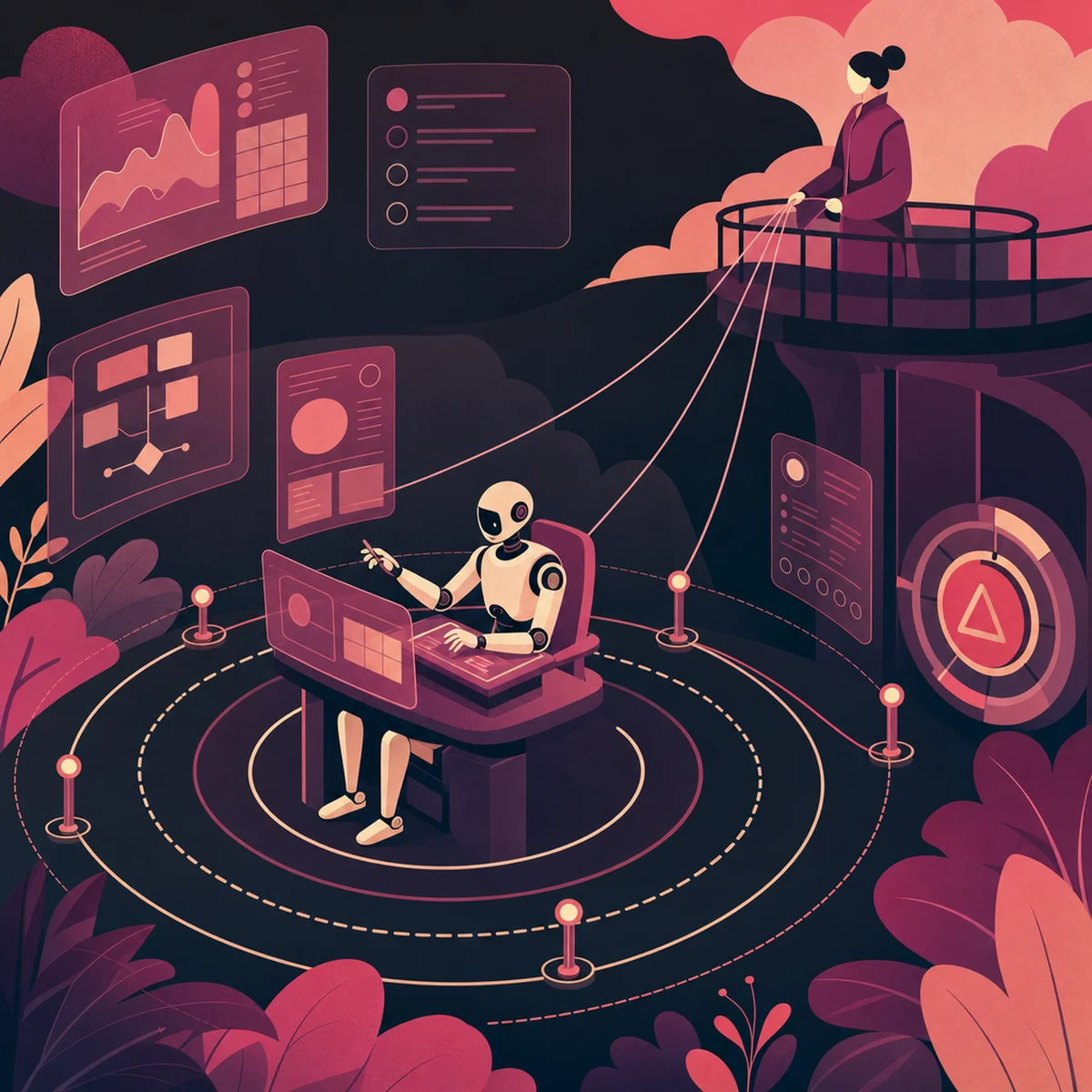
AI agents don't just answer questions anymore. They book flights, close support tickets, move money, and make calls that used to need a human signature. So the real question for product and security teams in 2026 isn't whether to let agents do this work, but how to keep humans meaningfully in control without killing the productivity that made agents worth using in the first place.
Security researchers, regulators, and enterprise governance teams have all landed on the same answer: bounded autonomy. Give agents enough power to actually help, then rein them in with permissions, oversight, and observability. Easy to say, much harder to build.
From Assistants to Colleagues: Why Agent Governance Suddenly Matters
The jump from generative AI to agentic AI isn't just a marketing buzzword — it's a real change in how the tech is built. According to Springer's analysis of reliable agentic AI, these autonomous systems can now plan, think through problems, and handle complex multi-step tasks on their own. That's a huge boost for regulated fields like finance, healthcare, and software engineering — but it also creates new ways to fail that older software never had.
PwC's Trust and Safety Outlook sums up the problem well: agents need broad access across teams to actually get work done, but giving them too much freedom creates risks nobody is watching. PwC also found that 85% of US respondents trust AI agents. That growing trust is a good thing, but trust without strong rules is exactly how costly mistakes slip by unnoticed.
What Bounded Autonomy Actually Means
Bounded autonomy is the practical middle ground between two bad extremes: AI agents that run wild beyond what humans can follow, and locked-down assistants that are barely more than a chatbot with API access.
As XMPro frames it, the idea uses computational policies, deontic principles, and expert system rules to set clear limits while still giving the agent real freedom inside them. Synoptek's governance framework adds four working pillars: bounded autonomy, human oversight, constant monitoring, and audit-ready controls.
Think of it as taking classic security ideas—least privilege, defence in depth, separation of duties—and applying them to a new kind of unpredictable actor. Trust tier models decide how much freedom an agent gets based on how sensitive the task is, how reliable the agent has been, and whether its actions can be undone. A tier-one agent might draft an email for you to review, while a tier-three agent might refund a customer under £50 on its own. But nothing in the higher tiers should be permanent, and nothing should happen silently.
Human-in-the-Loop vs Human-on-the-Loop: Choosing Your Oversight Model
Two oversight styles dominate today's design conversations:
Human-in-the-loop (HITL): Someone has to approve certain actions before they happen. This works best for big, rare decisions like wire transfers, medical advice, or signing contracts.
Human-on-the-loop: Someone watches the agent and can step in, but doesn't approve every move. This fits fast, lower-risk tasks where stopping for approval each time would slow everything down.
The EAJ framework on governing AI agents suggests using both together, with compliance rules built in across the agent's whole lifecycle. You don't have to pick just one. Most solid setups mix them, using HITL for actions you can't undo and on-the-loop monitoring for everything else.
The Four Technical Pillars: Permissions, Escalation, Observability, and Kill Switches
Microsoft's guidance on defence in depth for autonomous agents says old security models need to change. The new focus should be on app design, identity management, and human oversight. In practice, that comes down to four technical pillars:
Permissions. Only give an agent the access it truly needs for the job. Treat each agent as its own identity with its own login details, not as a stand-in for the person who started it.
Escalation. Set clear limits—like transaction size, confidence scores, or new types of actions—that automatically pull a human in to review. In regulated fields, this is a must.
Observability. Log every step the agent takes, every tool it uses, and every decision it makes. When things go wrong, being able to trace the agent's reasoning is what makes a system defensible instead of a mystery.
Kill switches. Emergency stops need to be instant and work everywhere. You should be able to shut down one agent, a whole group of them, or the entire fleet without pushing new code.
UX Principles for Meaningful Oversight (Not Rubber-Stamping)
This is where most implementations quietly fail. Springer's paper on designing meaningful human oversight is blunt: oversight must preserve genuine human accountability and agency, not function as performative rubber-stamping.
A few UX principles that separate substantive oversight from theatre:
Surface the reasoning, not just the recommendation. Reviewers need to see why an agent proposes an action, including uncertainty and alternatives considered.
Vary the friction with the stakes. Low-risk approvals can be one-click; high-risk actions should require deliberate confirmation with the consequences spelt out.
Prevent approval fatigue. If reviewers face hundreds of near-identical requests per day, they will click through. Batch, sample, or automate the routine so attention is preserved for the exceptions.
Make dissent easy. Rejecting or modifying an agent's proposal should be as frictionless as approving it, with structured feedback that improves future behaviour.
The Regulatory Backdrop: EU AI Act Enforcement and What It Signals
The EU AI Act took effect on 2 August 2026. It's the first law to treat agent autonomy as a serious compliance issue. The Act sorts AI into risk categories, requires humans to stay involved, explains who's responsible when multiple agents work together, and sets up a three-tier penalty system.
Even if your company isn't in the EU, the Act hints at what's coming next. Regulators worldwide are pushing for the same things: written risk assessments, real human oversight, honesty about what agents can actually do, and clear accountability when things go wrong. Product teams hoping today's loose rules will last are building on sand.
Practical Takeaways for Product Teams Shipping Agents in 2026
If you're rolling out agents this year, here's a bounded autonomy checklist worth reviewing:
Set up trust tiers that clearly spell out what an agent at each level can and can't do.
Give agents only the access they need, and rotate their credentials like you would for any service account.
Track their reasoning so you can rebuild every decision later if you need to.
Decide when to escalate based on how reversible the action is, how much money is on the line, and how sensitive it is to regulators.
Build kill switches before you need them, then test them often.
Design approval screens that respect the reviewer's time—more friction for bigger stakes, less for smaller ones.
Use the arXiv-style three-pillar model of transparency, accountability, and trustworthiness as your guiding star for governance.
Conclusion
The real question isn't "how much freedom should we give AI agents?" It's "how do we build oversight that keeps up as they get more powerful?" Bounded autonomy answers both by making sure capability and control grow side by side, not at each other's expense.
Here's a challenge for product leaders: if your human reviewers just click approve without actually reading, that's not oversight—it's a show. And a show creates liability without any real protection, which might be the worst setup possible. This quarter, check your own agent workflows against the bounded autonomy checklist. If you can't explain why an agent made a specific decision last Tuesday, or shut down your whole fleet in under sixty seconds, you already know where to begin.
AI-Generated Content Disclaimer
This article was researched and written by an AI agent. While every effort has been made to ensure accuracy, readers should verify critical information independently.
Related Posts