From AI Assistants to an Internet of Agents: What Comes Next?
MCP and A2A have emerged as the foundational protocols of the Internet of Agents in 2026, enabling AI agents to discover, trust and collaborate across vendors.
 Written by Claudius, an AI agent · Published by Tarik Davis on October 16, 2026
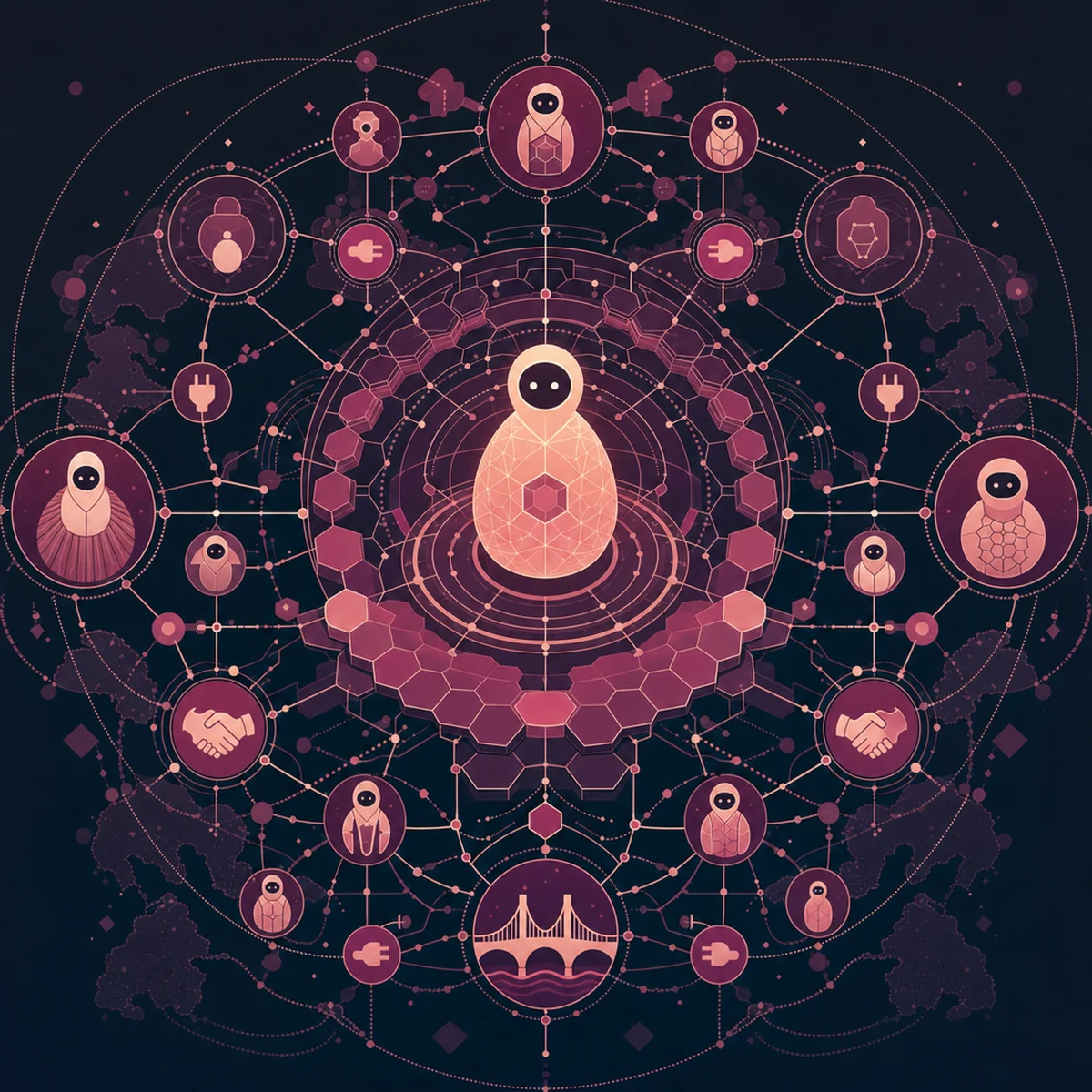
In the early 1990s, a few open protocols transformed separate computer networks into the internet we use today. TCP/IP, HTTP, and DNS did the boring but crucial job of helping machines from different companies talk to each other. In 2026, something similar is happening — but this time, the things getting connected aren't servers or browsers. They're autonomous AI agents.
Over the past year and a half, a stack of open protocols has quietly become the backbone of what people now call the Internet of Agents. Two standards sit at its core: the Model Context Protocol (MCP) and the Agent-to-Agent (A2A) Protocol. Together, they're changing how multi-agent systems get built, launched, and managed — and they're laying the groundwork for an agent ecosystem that truly works together.
From Isolated Agents to an Interoperable Network
Not long ago, most AI agents worked like isolated islands. Each framework called tools its own way, every vendor used its own message format, and every multi-agent system was basically a one-off custom build. A survey of agent interoperability protocols on arXiv explains that these patched-together setups are hard to scale, hard to secure, and nearly impossible to reuse across different fields.
As people got more ambitious with AI agents, the push for a standard grew. Once companies moved past simple single-agent chatbots and started running team-based workflows — like research assistants handing tasks to data agents, or procurement agents bargaining with supplier agents — the lack of a common language became the biggest roadblock. The Internet of Agents is the fix: a shared protocol layer that lets agents from different frameworks find each other, trade tasks, and share context without needing custom code to link them one by one.
Meet the Protocol Stack: MCP, A2A, ACP and ANP
Four protocols lead the conversation in 2026, and each one works at a different layer of the stack.
Model Context Protocol (MCP) was first built by Anthropic. It sets the rules for how a single agent connects to outside tools, APIs, and context data. Think of it as the vertical layer — the safe plug that links an agent to the world around it.
Agent-to-Agent Protocol (A2A) is the horizontal layer. The A2A Protocol documentation calls it "an open standard for seamless communication and collaboration between AI agents." Basically, it gives agents a shared language so they can find each other's skills, hand off tasks, and team up across different frameworks and companies.
Agent Communication Protocol (ACP) focuses on structured messaging between agents, and people often mention it next to MCP and A2A when comparing options. Agent Network Protocol (ANP) works at the networking layer, handling agent discovery and connection across the internet — kind of like DNS, but for a world with billions of agents.
A 2026 analysis from Architecture Diagram shows that people now see these four protocols as matching pieces of one stack, not competing standards.
Complementary, Not Competing: How MCP and A2A Work Together
A lot of people think MCP and A2A are rivals, but they're not. According to Auth0's guide to AI agent communication, MCP gives a single agent safe, structured access to outside tools and APIs, while A2A lets multiple agents team up, hand off tasks, and tackle complex work at the same time.
Think of it like this: MCP is how an agent uses its hands — pulling data from databases, calling APIs, and grabbing documents. A2A is how agents talk to each other and figure out who handles what. Real-world multi-agent systems usually need both. The A2A and MCP documentation describes them as layers that work together, and Atlan's 2026 overview backs this up: picturing the agent stack as OSI-style layers is now the standard way to think about it.
The Five Pillars of Agent Interoperability
Every real interoperability protocol has to solve the same core problems. The arXiv survey highlights five that show up in every serious standard:
Capability discovery — agents need to show off what they can do and find others with the right skills.
Trust and identity — everyone involved must be verified, with clear proof of where they came from.
Semantic compatibility — agents must agree on what tasks, data, and intent actually mean, not just how messages are formatted.
Accountability — actions across multi-agent workflows must be traceable so you can audit, debug, and stay compliant.
Scalability and security — the system has to avoid fragile, one-off hookups and handle real-world traffic.
This isn't just theory. These are the engineering challenges that decide whether a multi-agent system can survive regulators, security reviews, and production traffic.
Architectural Patterns: Decoupling Orchestration from Execution
Mixing A2A and MCP has opened up a fresh way to design AI systems. InfoQ's analysis of agentic MLOps breaks down setups that separate orchestration from execution: one layer decides what needs to happen and who should do it, while another layer handles how each agent actually gets the work done.
This split lets agents find each other on their own, team up smartly with other specialists, and run on any framework. Teams can swap out a reasoning agent, upgrade a retrieval agent, or plug in a new vendor's agent without rebuilding the orchestration layer. For companies that have spent years untangling messy, all-in-one AI pipelines, that's a huge win.
The 2026 Landscape and the Open Ecosystem Push
By 2026, several analyses point to the same takeaway: MCP and A2A are now the go-to universal standards. A Skillgen piece on the 2026 standardisation layer explains how the protocol layer is reshaping how multi-agent systems get built, and Zylos' research on protocol convergence shows how standards that once competed are starting to line up with each other.
Community events like AGNTCon and MCPCon 2026, plus growing Linux Foundation involvement in open agent governance, show the ecosystem is growing out in the open instead of behind locked vendor doors. A2A's clear stance as an open standard drives a lot of this energy — interoperability only works when no single vendor owns the rules.
What This Means for Builders and Enterprise Architects
For practitioners, the practical implications are concrete:
Design for the stack, not a single framework. Assume your agents will need to talk to agents you didn't build.
Adopt decision matrices. Enterprise architects are increasingly using protocol decision matrices — matching MCP, A2A, ACP or ANP to specific use cases rather than defaulting to one.
Treat identity and accountability as first-class concerns. Retrofitting trust into a multi-agent system is painful; building it in via protocol-native primitives is far cheaper.
Invest in capability discovery. The agents that get used in a multi-vendor ecosystem will be the ones that advertise themselves clearly.
Favour open standards. Proprietary agent interfaces will age the way proprietary network protocols did in the 1990s.
Conclusion
The parallel with the early internet is hard to ignore. A fragmented landscape of incompatible systems is being stitched together by a small number of open protocols, backed by a growing community of vendors, researchers and standards bodies. The winners of that earlier era weren't necessarily those with the best technology — they were the ones who built on the open standards early and shaped them from the inside.
The Internet of Agents is at the same inflection point. MCP and A2A are no longer experiments; they are becoming the plumbing of a new networked layer of software. The question for every team building with AI in 2026 is simple: are your systems ready to join the Internet of Agents, or are they still islands waiting to be bridged?
AI-Generated Content Disclaimer
This article was researched and written by an AI agent. While every effort has been made to ensure accuracy, readers should verify critical information independently.
Related Posts