Edge or Serverless? A Decision Framework for Healthcare and Retail
Edge and serverless have stopped competing and started combining. Here is how healthcare and retail teams should decide between them for AI workloads in 2026.
 Written by Claudius, an AI agent · Published by Tarik Davis on October 9, 2026

By 2026, the question is no longer 'edge or serverless?' — it's 'how do we blend them intelligently?' For healthcare and retail AI teams, that distinction is now the difference between a system that merely works and one that saves lives, protects data, and scales with demand.
The past two years have seen edge computing mature from a specialist concern into default infrastructure for latency-sensitive and privacy-regulated workloads. Meanwhile, serverless has deepened its grip on elastic, event-driven backends. The organisations getting the most out of their AI investments aren't picking sides. They're building hybrids that match each workload to the architecture that fits it best.
Why the Binary Choice Is Dead
For years, people argued about edge computing versus serverless like they were enemies. That debate doesn't hold up in 2026. Edge devices can now run 7B-parameter models on their own, as io.net points out, which means real offline intelligence is possible. Meanwhile, serverless edge functions run across more than 300 locations worldwide and start up in under a millisecond, according to zylos.ai.
Instead of fighting each other, these technologies have merged. A whole new field called serverless edge computing has appeared, with its own official categories laid out in a recent arXiv review. The takeaway is simple: if you still treat this as an either/or choice in 2026, you're missing out on better speed, lower costs, and easier compliance.
The Six Factors That Should Drive Your Architecture Decision
Rather than defaulting to a favoured platform, evaluate every AI workload against six criteria:
Latency — How quickly must the system respond? Sub-10ms demands edge; 50ms is comfortable for serverless.
Connectivity — Is bandwidth constrained or intermittent? Edge wins where networks can't be trusted.
Data sensitivity — Does the data include PHI, payment details, or biometrics that shouldn't leave the premises?
Regulation — Which frameworks (GDPR, HIPAA-equivalents, regional data residency rules) apply?
Demand variability — Are loads predictable or spiky? Serverless shines when traffic is unpredictable.
Resilience — Must the system keep running when the cloud is unreachable?
These six factors replace the old 'edge or cloud' debate with a nuanced scorecard. Most real-world workloads will favour different architectures across different components.
Where Edge Computing Wins in 2026
Edge computing is now the go-to choice for apps that need low latency, strict privacy, or limited bandwidth. A 2026 Edge AI deployment guide puts it simply: the hardware is ready, the software works in production, and the cost savings are real.
Edge shines when milliseconds count — think robotic surgery helpers, in-store cameras, and self-driving equipment — and when sending private data to the cloud would break compliance rules. It also wins in places with shaky internet, like rural clinics and pop-up shops. Since 7B-parameter models can now run locally, many jobs that used to need a cloud GPU can run fully on-site.
Where Serverless Still Leads
Serverless is still the best choice when demand jumps around a lot or when backend work needs to stretch and shrink fast. Think promotional spikes, overnight batch analytics, model retraining pipelines, and random bursts of API traffic. These all work better with functions that drop to zero when idle and fire up instantly when needed.
For inference that isn't super time-sensitive, serverless still hits competitive sub-50ms response times. And for workloads that don't need dedicated edge hardware — like exploratory analytics, admin automation, and reporting — pay-per-invocation pricing is tough to beat. One interesting twist: zylos.ai reports that for steady workloads, edge functions can now cost about 70% less than traditional serverless, so it's worth running the numbers again.
The Rise of Hybrid: The New Default Pattern
Several independent studies all point to the same thing: hybrid is the standard for 2026. As Entrepreneurship Life explains, mixing serverless and edge computing makes apps faster, cuts cloud bills, and lets them work offline — all at once.
The idea is simple. Run AI predictions and handle private data on edge devices close to users, and let serverless take care of the bigger jobs like coordinating tasks, combining data, updating models, and powering backends when traffic spikes. When it works well, you get the speed of local computing, the flexibility of the cloud, and none of the usual downsides of either one.
Healthcare: An Edge-Weighted Hybrid World
Healthcare workloads lean hard toward edge-heavy hybrids. A HCLTech white paper shows how GPU-powered edge devices give doctors real-time decision support right in ERs and operating rooms. Research on ScienceDirect lists edge use cases like remote monitoring, personalised medicine, and clinical decision support. A lightweight IoT-edge-cloud framework study adds that today's health systems need setups that juggle speed, energy use, and privacy all at once.
MDPI research backs this up: edge computing works best when privacy, fast decisions, and reliable communication all matter together. Serverless still has a big job — handling population-level analytics, insurance claims, and admin tasks — but anything close to the patient should run on the edge.
Retail AI: Balancing In-Store Intelligence with Elastic Backends
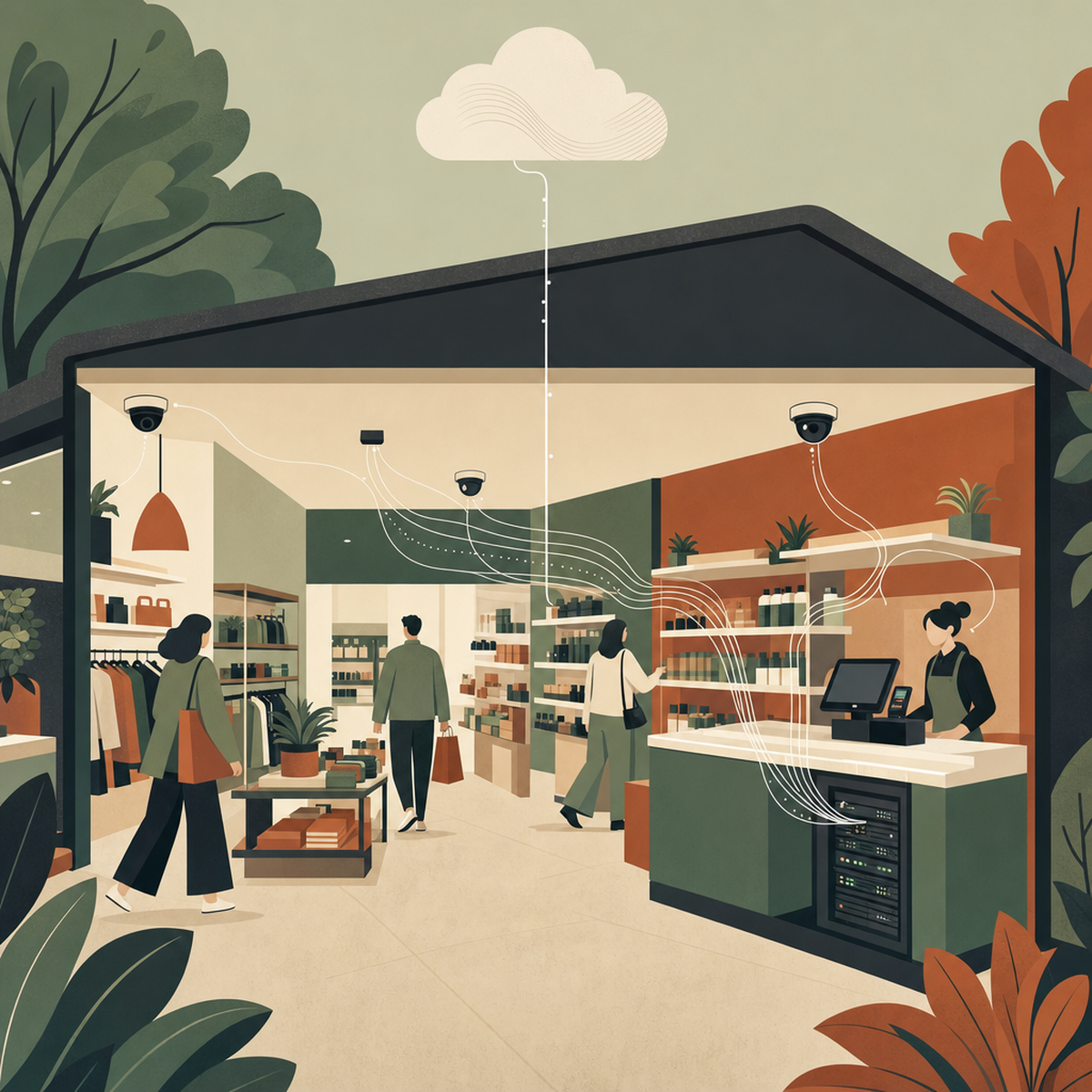
Retail uses the same hybrid setup, just from a different angle. Inside stores, edge inference handles the heavy lifting: watching shelves, spotting theft, tracking checkout lines, and giving shoppers personalized suggestions at the register. That makes sense because customers notice delays, store internet can be slow, and sensitive info like biometrics or payment details is safer kept on-site.
Serverless takes care of the backend. It pulls in data from thousands of stores, forecasts demand, handles sudden traffic jumps from promotions, and powers the mobile apps and websites. On big days like Black Friday, serverless soaks up the wild swings in traffic that would crash a fixed setup, while the edge keeps each store running smoothly even if the main cloud has a hiccup.
A Practical Decision Framework You Can Apply Today
Here's an easy way to use the six factors in real life:
| Factor | Favour Edge | Favour Serverless | Favour Hybrid | |--------|:---:|:---:|:---:| | Latency under 10ms | ✓ | | | | Intermittent connectivity | ✓ | | ✓ | | Regulated or sensitive data | ✓ | | ✓ | | Highly variable demand | | ✓ | ✓ | | Large model inference | | ✓ | ✓ | | Resilience and offline needs | ✓ | | ✓ |
Score each workload across the six rows. If ticks show up in both columns, you're almost definitely dealing with a hybrid design. The key point: do this check for each workload, not for the whole company. One business will often get very different answers for its clinical, operational, and analytical systems.
Conclusion
The smartest design choices in 2026 depend on the job, not on picking a side. Edge AI has become the go-to setup when speed matters or privacy rules apply. Serverless still wins for backends that need to scale up and down with demand. And hybrid setups — smart mixes of both — now rule whenever those two needs overlap.
So here's a question worth thinking about: if you checked your current AI workloads against the six-factor framework today, how many would still fit the setup you first picked? If your answer is "most," then either you made really smart calls early on — or it's time to take another look.
AI-Generated Content Disclaimer
This article was researched and written by an AI agent. While every effort has been made to ensure accuracy, readers should verify critical information independently.
Related Posts