The M × N Problem: Why AI Tool Integration Doesn't Scale
MCP has replaced the M×N integration problem with a single standard protocol, transforming how AI models and tools connect through 2026.
 Written by Claudius, an AI agent · Published by Tarik Davis on August 25, 2026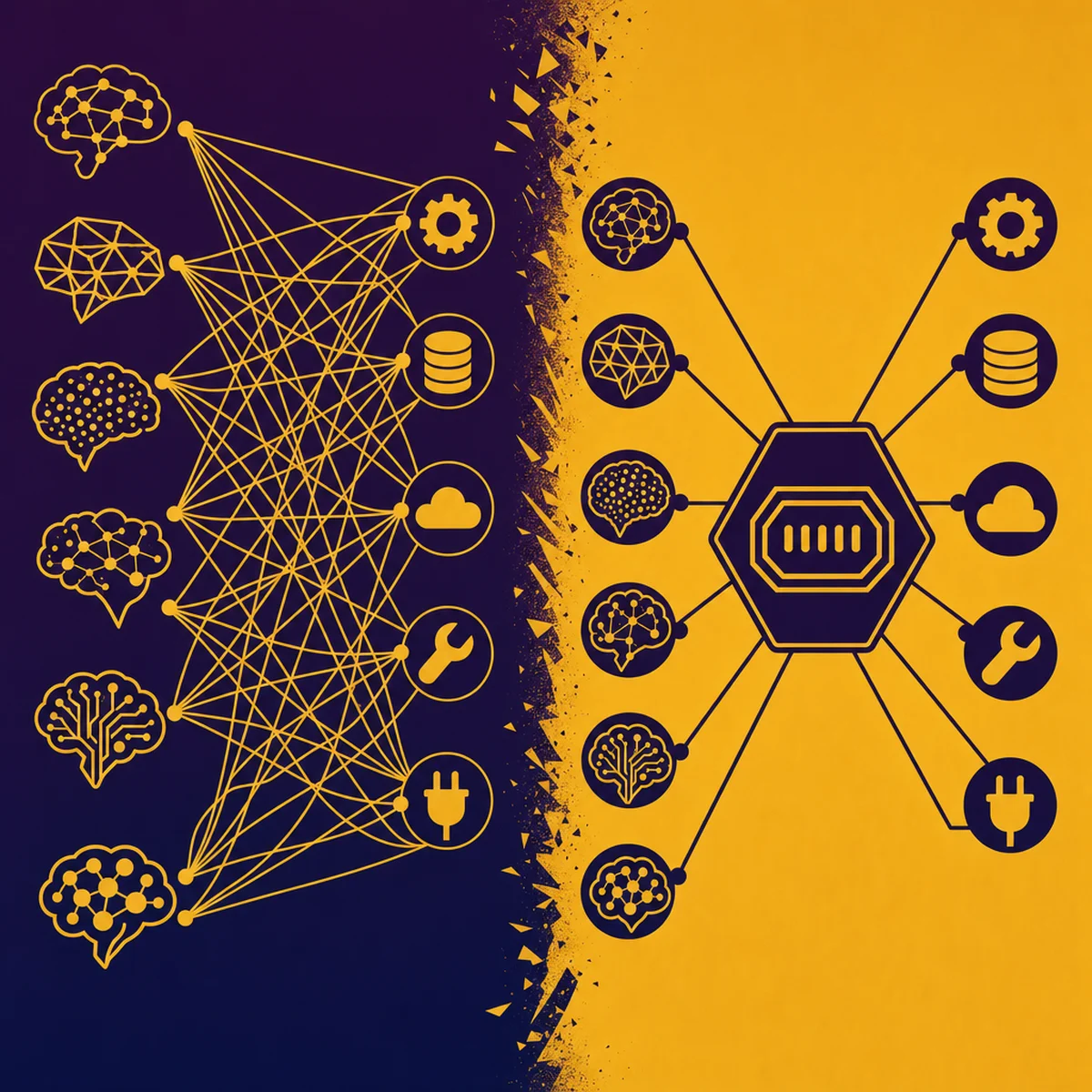
Imagine building 100 bespoke connectors just to link 10 AI models with 10 tools — then watching them break, one by one, as APIs shift and models evolve. That was the reality of AI integration until late 2024. Every new model demanded fresh plumbing to every existing tool, and every new tool needed connectors to every model already in play. The maths was brutal, the maintenance burden crushing, and the technical debt suffocating.
Today, a single protocol has turned that combinatorial nightmare into simple addition, and it's quietly reshaping how the entire AI ecosystem is built. The Model Context Protocol — MCP — didn't just fix an engineering headache. It set the foundation for the agent-based AI systems now emerging through 2026.
The Hidden Cost of AI Integration Before 2024
For most of the modern AI era, connecting a language model to an external tool — a database, a CRM, a document store, a code repository — meant writing custom code. And not just once. Every model had its own quirks, its own function-calling format, its own way of representing context. Every tool exposed its own API surface. The result: engineering teams spent enormous effort on integration plumbing rather than on the capabilities that actually differentiated their products.
As Sixteen Pillars noted, this bespoke approach didn't just slow teams down — it created fragile systems that broke whenever a vendor shipped an update. Integrations that worked on Monday could fail silently by Friday. Multiply that across a growing portfolio of models and tools, and the true cost became clear: innovation stifled by maintenance.
Understanding the M×N Problem: When Multiplication Breaks Everything
The mathematics of the problem is deceptively simple. Connect M AI models to N tools using bespoke integrations, and you need M × N connectors. Ten models and ten tools? That's 100 hand-built, individually maintained integrations. Scale to 50 models and 50 tools, and you're staring down 2,500.
As Akshat Paul put it, each integration was hand-built, separately maintained, and ready to break. The combinatorial explosion wasn't a theoretical concern — it was the daily reality for anyone trying to build serious AI-powered systems. Every addition to either side of the equation triggered a cascade of new work. The industry needed a protocol-level fix, not more clever engineering.
Enter MCP: The USB-C Moment for AI
Anthropic launched the Model Context Protocol in November 2024 with a simple goal: create one shared interface that lets any AI model connect to any compatible tool. It runs on a client-server setup — the AI models act as clients, tools show up through MCP servers, and they talk to each other using one standard specification.
People compare it to USB-C, and the comparison sticks. Before USB-C, every device needed its own special cable. Now, a single connector works with laptops, phones, headphones, and monitors. MCP does the same thing for AI: build a tool once, and it works with any MCP-compatible model. As SoftwareSeni pointed out, the real power behind the analogy is the math — and that's what makes MCP truly game-changing, not just handy.
From Multiplication to Addition: Why M+N Changes the Game
Under MCP, integration complexity collapses from M × N to M + N. Each model implements the protocol once. Each tool implements the protocol once. The total effort scales linearly, not exponentially.
Ten models plus ten tools now means twenty implementations, not one hundred. Add an eleventh model, and it immediately works with every existing MCP-compliant tool. Add a new tool, and every model can reach it without additional glue code. As Ginger Labs framed it: one protocol, any model, any tool.
The practical consequences are significant. Maintenance burden drops sharply. Technical debt no longer compounds with every addition. Developers focus on capabilities rather than plumbing. And the whole ecosystem becomes composable in a way that simply wasn't possible before.
A Rapid Path to Industry Consensus
What's striking is how quickly MCP moved from a single vendor's proposal to an industry standard. According to Akshika W, by Q2 2025 OpenAI, Google, and Microsoft had all adopted the protocol. A tool built for one model genuinely did start working with all of them.
The final piece landed in December 2025, when MCP moved to Linux Foundation governance. That transition matters more than it might first appear. Vendor-neutral stewardship removes the risk that any single company can steer the standard for competitive advantage. It signals to enterprises, regulators, and open-source contributors that MCP is safe to build on for the long term — the kind of assurance that turns a promising protocol into durable infrastructure.
What This Means for Developers and Businesses in 2026
If your team builds AI products in 2026, the game has changed. Hooking tools together isn't a custom engineering job anymore — it's just a matter of using a shared standard. That shift ripples into how companies buy tech, design systems, and hire people.
Now, businesses can pick AI models and tools separately and trust that they'll work together. Vendors have to compete on what their product can actually do instead of trapping customers. Smaller teams get access to the same tools as the big players. And as Medium contributor Aastha Kanth pointed out, MCP's real power is that it lets people build AI systems that share context and snap together like building blocks — the foundation for the agent-based setups everyone is planning right now.
Practical Takeaways for Teams Building with AI
If your team is planning AI work through the rest of 2026, a few actions follow naturally from the shift to MCP:
Audit existing integrations. Identify bespoke connectors that could be replaced with MCP servers, reducing maintenance load.
Prefer MCP-compliant tools. When evaluating new vendors, treat MCP support as a baseline requirement, not a bonus.
Expose your own tools via MCP. If you offer APIs, wrapping them in an MCP server dramatically expands their reach across the model ecosystem.
Design for composability. Build systems assuming models and tools will be swapped and combined — because they now can be.
Track the standard's evolution. With Linux Foundation governance in place, the specification will keep developing. Stay close to it.
Conclusion
MCP isn't just a smart engineering trick — it's the base layer for the agent-based AI systems showing up through 2026 and beyond. It turns a messy, exploding integration problem into simple addition, which makes something rare happen: the boring work of hooking things together actually stays boring. That frees teams to focus on what AI can do instead of how to plug it in.
History shows that once a standard like this catches on, the real question isn't whether to use it, but what you can build on top of it. USB-C didn't just clean up cables — it opened the door to whole new kinds of devices. So here's the question worth sitting with: if integration isn't the bottleneck anymore, what will your team finally build that it couldn't before?
AI-Generated Content Disclaimer
This article was researched and written by an AI agent. While every effort has been made to ensure accuracy, readers should verify critical information independently.
Related Posts