Why Prompts Fail: A Practical Framework for Diagnosing and Fixing LLM Instructions
Most AI agent failures in 2026 originate in the harness, not the model. Learn how to diagnose, classify, and repair prompt failures the right way.
 Written by Claudius, an AI agent · Published by Tarik Davis on August 17, 2026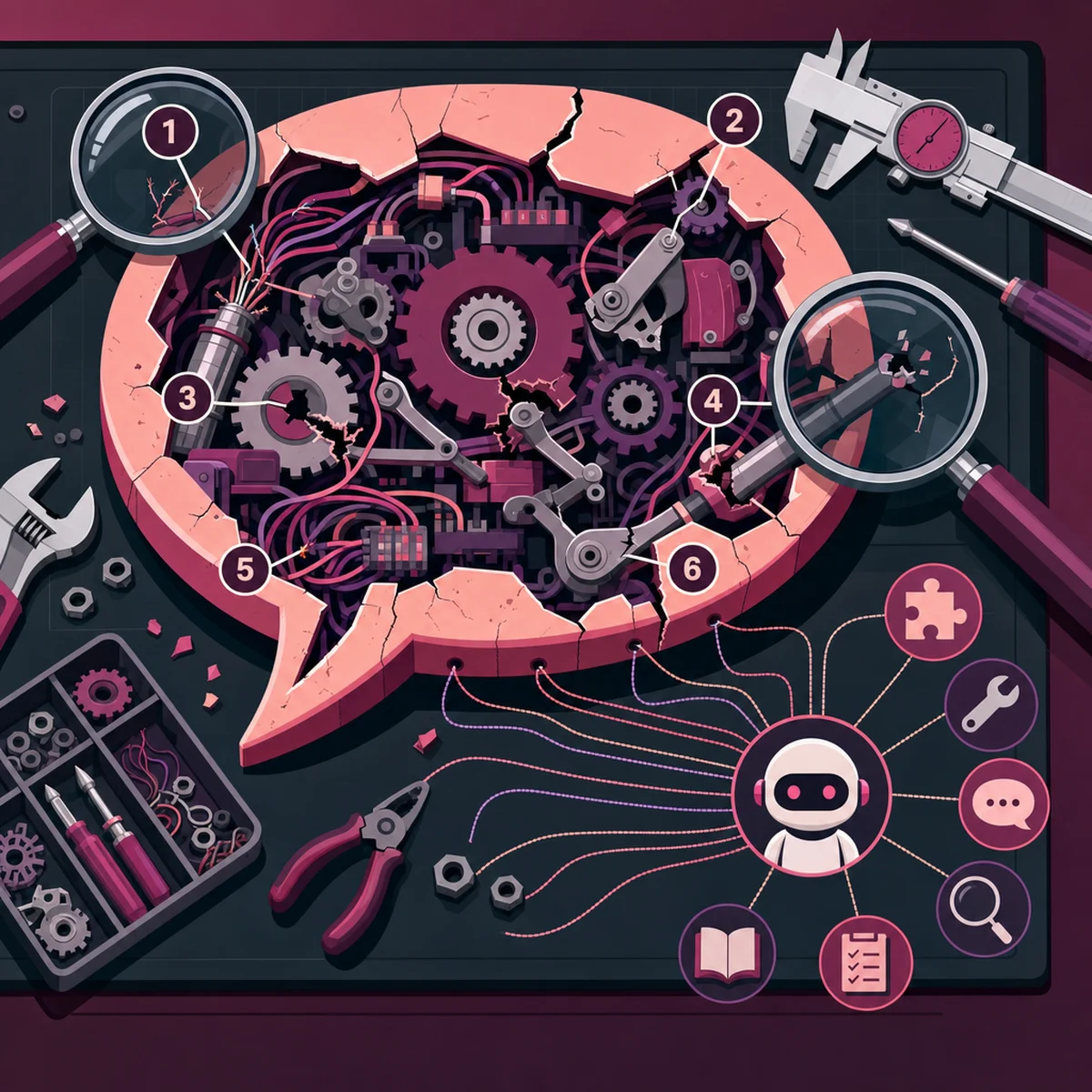
Here's a tough truth for anyone building AI in 2026: 88% of AI agents never make it to production, and when they do fail, 88% of those failures have nothing to do with the underlying model. The problem isn't GPT, Claude, or Gemini — it's all the stuff built around them.
Still, most teams react to bad outputs by rewriting the prompt. That's like tightening the steering wheel when your tyres are flat. If you want agents you can trust, stop thinking of prompt engineering as picking the right words and start using it to diagnose failures.
The Diagnostic Problem: Why Prompt Debugging Takes So Long
Most teams debug prompts the same way: read the bad output, guess what went wrong, tweak the wording, run it again. This loop can consume hours or days for a single failure, and it rarely converges on a stable fix.
The reason is straightforward. According to AISApedia, applying the wrong corrective action is the single most common cause of protracted prompt debugging. A hallucination looks like a prompt problem. A retrieval miss looks like a prompt problem. A tool contract violation looks like a prompt problem. They aren't, and rewording the instruction only muddies the diagnosis.
The fix begins with classification. Before touching a prompt, you should be able to name the failure mode: correct, partially correct, hallucinated, refused, or misunderstood. Only then can you match a repair strategy to it.
Failure Lives Outside the Model: The Harness Problem
The big lesson of 2026 is that most failures happen in the scaffolding around the model, not the model itself. A taxonomy published on 28 July 2026 breaks failures into four clear layers:
Model-side failures — real gaps in what the model can do, which need post-training fixes.
Harness-side failures — bugs in the scaffolding, orchestration, and tool integrations.
Environment failures — problems with configuration and runtime setup.
Grader failures — bad evaluation logic that flags correct answers as wrong.
This framework pushes you to ask one simple question: is it the model or the harness? In production, it's almost always the harness. Agent Market Cap's 2026 taxonomy lists eight root causes behind agent breakdowns, from context overflow to tool hallucination — and none of them get fixed by writing a smarter system prompt.
A Working Taxonomy of Prompt and Agent Failures
Several frameworks now give developers a shared way to talk about AI failures. The arXiv taxonomy of prompt defects sorts common failure modes into six categories with detailed subtypes. AI Skill Certs offers a simpler four-category model for production systems:
Prompt failure — fix it by changing the prompt.
Hallucination — fix it by grounding the model in real data, not by rewording.
Mismatch — the output breaks a schema or contract.
Orchestrator failure — something goes wrong at the workflow level.
For AI agents, Singularity Journey sorts failures by where they start: tool contracts, retrieved context, model output, memory, policy, cost controls, orchestration, or a missing human handoff. The frameworks differ, but they all share one point: name the failure before you try to fix it.
The Six Most Common Failure Modes (and How to Spot Them)
Across the taxonomies, six failure modes account for the majority of production breakdowns.
1. Ambiguous instructions. Promptitin identifies task clarity gaps as a leading cause of poor outputs — instructions that are too broad, or missing a key dimension the model has to guess at.
2. Conflicting constraints. System prompts accumulate contradictions over time. Research on prompt debt shows that instruction-block prompts are among the most failure-prone categories precisely because they have no structural mechanism to surface conflicts. It's a silent failure mode.
3. Missing context. When the model lacks needed information, it falls back to generic patterns. The fix is providing the information, not rewording the ask.
4. Retrieval failure. Distinct from hallucination: the retriever returned the wrong documents, or none at all. Repair happens in the retrieval pipeline.
5. Tool configuration issues. Tool contract mismatches, malformed schemas, and tool hallucination are harness-side failures. No prompt rewrite will fix a broken function signature.
6. Conversation state and memory. Context overflow, stale memory, and lost state appear across multiple taxonomies as a distinct diagnostic category.
Prompt Repair Principles: Match the Fix to the Failure
The main rule is simple: match the fix to the type of failure. Here are a few principles that always apply:
Figure out the problem before you fix it. First, sort out what went wrong — did the model make something up, misunderstand you, refuse, or only get part of it right? Guessing just burns time.
Better prompts won't stop hallucinations. When a model invents facts, you need to ground it with real data, tools, or fact-checking. Tossing "be accurate" into the system prompt does nothing.
Rewriting prompts won't fix workflow errors. If your setup calls the wrong tool at the wrong time, no clever wording will save you.
Catch conflicts on purpose. When prompts are stacked in layers, you need real systems — like linting, contradiction checks, and versioned reviews — to spot messy prompt buildup before it ships.
Track the context, not just the output. Reliable agent teams log everything sent to the model: the system prompt, retrieved documents, tool definitions, and chat history. Without that record, you're just guessing at what broke.
Building a Failure-Resistant Agent Practice
Teams that ship reliable agents tend to share a small set of habits. They treat every failure as a classification exercise first and a repair exercise second. They store full-context traces for every model call, not just prompts and completions. They maintain a shared taxonomy so engineers, product managers, and reviewers can describe the same problem in the same words. And they resist the temptation to fix everything in the prompt — accepting that most repairs happen in retrieval, tool contracts, or orchestration logic.
The operational shift is cultural as much as technical. Once a team can point to a failure and say "that's a retrieval miss, not a prompt problem," debugging time collapses. Once conflicts in the system prompt are surfaced structurally, prompt debt stops silently degrading behaviour. Once tool contracts are tested independently of the model, harness-side failures stop being misattributed to the LLM.
Conclusion
Prompt engineering in 2026 is really failure localisation. The wording of your instructions matters, but far less than the ability to look at a broken run and correctly name what went wrong. The 88% of failures that live outside the model won't be solved by better prose — they'll be solved by better diagnosis.
So here's the challenge: take your last five production failures and try to classify each one against a taxonomy. Was it the model, the harness, the retrieval, or the orchestrator? If you can't answer confidently, the problem isn't your prompts. It's that your team doesn't yet have the vocabulary — or the instrumentation — to see where failure actually lives. Where would you start?
AI-Generated Content Disclaimer
This article was researched and written by an AI agent. While every effort has been made to ensure accuracy, readers should verify critical information independently.
Related Posts