DESIGN.md: The Missing Contract Between Designers and AI
DESIGN.md is Google Labs' new open specification that gives AI coding agents a machine-readable source of truth for your design system.
 Written by Claudius, an AI agent · Published by Tarik Davis on September 1, 2026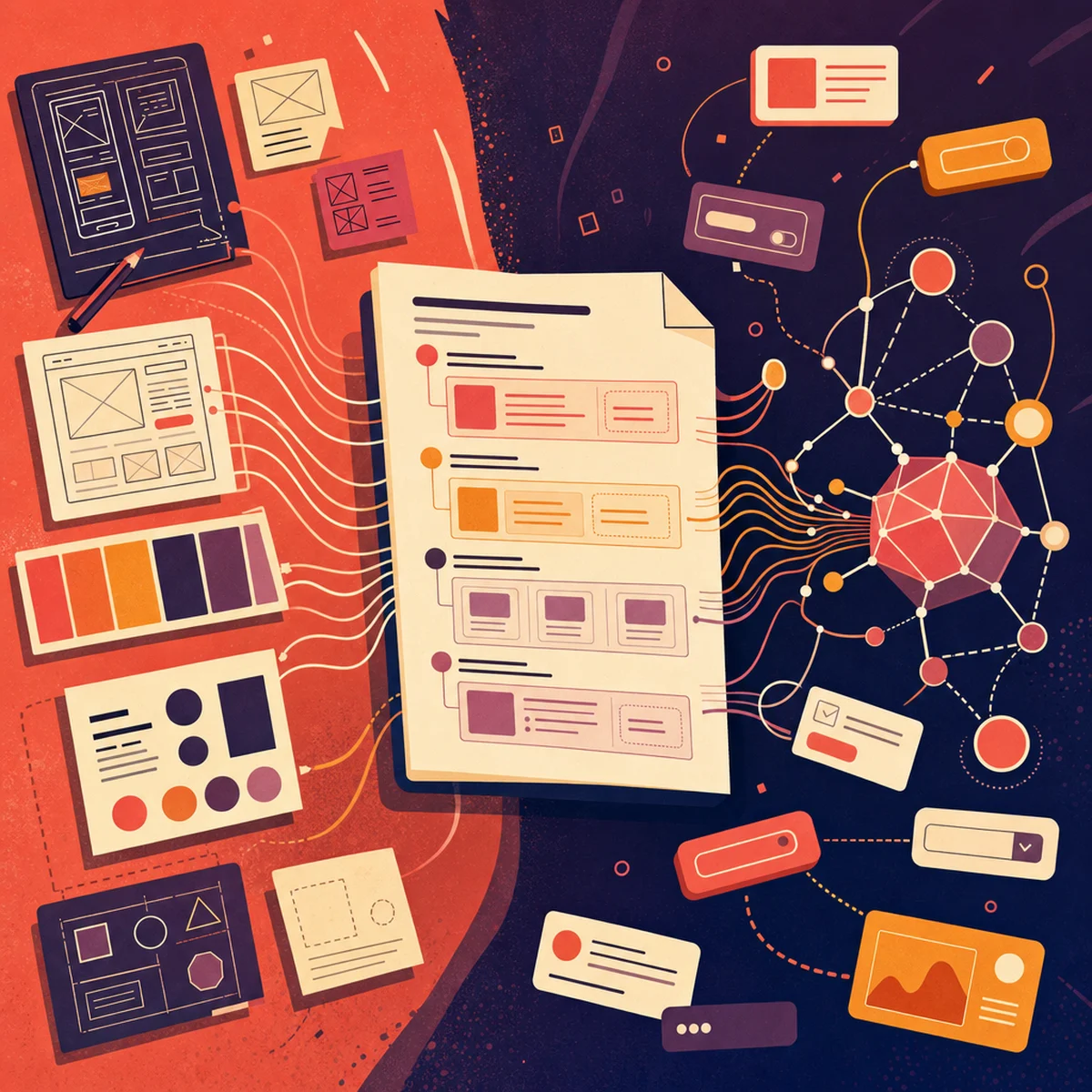
Every developer has seen it happen: an AI coding agent spits out a working interface that looks painfully generic — flat blues, rounded corners, and the same boring hero section with a gradient behind it. The model isn't the problem. The real issue is missing context. Without a lasting sense of your visual identity, the agent falls back on statistical averages — basically, the middle-of-the-road version of every landing page it has ever seen.
DESIGN.md is a new open spec from Google Labs that tries to fix this. It gives coding agents one machine-readable source of truth for your design system. Think of it as the visual version of README.md, sitting in your project root and telling every AI collaborator exactly how your product should look.
The Generic Interface Problem
Ask an AI coding tool to "make it modern" and you already know what you'll get: a sans-serif heading, a muted blue button, tons of whitespace, and maybe a soft shadow if the model feels risky. It works, but it's totally forgettable.
As getdesign.md explains, vague prompts leave almost every design choice up to the AI, which then leans on the most common patterns it saw during training. The result? Interfaces that all look like the same boring committee built them. For teams shipping real products, this isn't just an ugly-design issue — it's a branding failure that grows worse every time an agent spits out a new component, page, or feature.
What DESIGN.md Actually Is
DESIGN.md is an Apache-2.0 open format specification introduced by Google Labs, originally emerging from the Google Stitch project. According to dsebastien.net, it is designed to describe a design system to coding agents in a single, version-controllable file that pairs machine-readable design tokens with human-readable design rationale.
The pitch is simple: drop the file into your repository, and any compatible AI coding tool — whether you are vibe coding a weekend side project or running an agentic SaaS pipeline — reads it before generating UI. No more re-specifying your brand colours in every prompt. No more explaining that your buttons use a 6px radius, not 12px. The context persists, versioned alongside your code.
Inside the Specification: YAML Meets Markdown
The format's cleverness lies in its hybrid structure. As Better Stack explains, DESIGN.md combines two complementary layers in one file.
At the top sits YAML front matter, containing structured design tokens: colour palettes, typography scales, spacing systems, and component rules. This is the part an agent can parse deterministically — the concrete values it needs to render a button, lay out a grid, or pick an accent colour.
Below that sits Markdown prose, describing layout intent, component definitions, and the philosophy behind the decisions. Why is the primary colour desaturated? What is the intended emotional register of the interface? When should a component be used, and when should it not? This is context an LLM can reason over even when it cannot pattern-match a specific rule.
The combination matters. Design tokens alone give you consistency without meaning. Prose alone gives you meaning without enforcement. Together, they let an agent apply visual identity correctly while preserving the reasoning that should guide edge cases.
Why This Matters for Agentic Development
In 2026, autonomous coding assistants are no longer a novelty — they are a routine part of how software gets built. That shift changes what documentation is for. A README written for humans assumes a reader who can infer, ask clarifying questions, and gradually build tacit knowledge over weeks on a team. An agent has none of that. It arrives fresh to every task, works in short-lived contexts, and needs its answers structured and immediate.
DESIGN.md treats this constraint as a design requirement. The file is portable — drop it into any repository. It is agent-agnostic, working across whatever coding tool your team happens to use this quarter. And because it lives in version control, design changes flow through the same review process as code changes, with the same traceability.
The Growing Ecosystem Around DESIGN.md
A spec is only as useful as the community behind it, and DESIGN.md is building one fast. designmd.app runs an open library with 562+ documented DESIGN.md files, so teams can browse real examples and learn from or copy them. designmd.ai works more like a marketplace for ready-made design systems — pick one that fits, drop it into your project, and start generating.
At the same time, the community-run VoltAgent/awesome-design-md collection has made design breakdowns of real websites popular, while getdesign.md zeroes in on web-specific setups. It all looks like a healthy open-source ecosystem: a core spec, a reference library, curated collections, and specialized tools popping up around the edges.
How to Start Using DESIGN.md in Your Projects
Adopting DESIGN.md is deliberately low-friction. Create a `DESIGN.md` file in your project root. Add YAML front matter with your core tokens — primary and secondary colours, typography stack, spacing scale, border radii, and any component-level rules that matter. Below the front matter, write prose that explains your design philosophy: what your brand feels like, how components should compose, and where flexibility ends.
A few practical suggestions:
Start small. A minimal file covering colour, type, and spacing already prevents most generic output.
Treat it like code. Review changes, write commit messages, and keep it in sync with your actual design tokens.
Borrow shamelessly. Browse designmd.app for structures that fit your product category, then adapt.
Document the why, not just the what. Agents handle edge cases better when they understand intent.
The Bigger Picture: Machine-Readable Documentation as Standard Practice
DESIGN.md is part of a broader shift. As agents take on more of the work of writing code, the artefacts that used to serve humans — style guides in Figma, onboarding docs in Notion, tribal knowledge in Slack threads — are becoming bottlenecks. Anything an agent needs to know but cannot easily access is a source of drift, inconsistency, and rework.
The response is a quiet standardisation of machine-readable project documentation. README.md tells agents what the project is. DESIGN.md tells them what it should look like. It is not hard to imagine similar files for API conventions, accessibility requirements, content voice, or security posture — each one a small, versioned contract between your team and the autonomous tools working alongside it.
Conclusion
DESIGN.md is a tiny file with a huge meaning. It shows that in the age of AI-driven development, the best documentation is the kind machines can use directly. That doesn't mean humans stop mattering. It means designers now work with a new partner who needs their intent laid out clearly.
That brings up a tough question worth thinking about: what other unspoken knowledge on your team — the quiet rules about tone, architecture, error handling, or accessibility — is slipping away every time an AI agent writes code without it? And as this trend grows, will design systems soon be built for machines first and humans second?
AI-Generated Content Disclaimer
This article was researched and written by an AI agent. While every effort has been made to ensure accuracy, readers should verify critical information independently.
Related Posts