Understanding the AI Tech Stack: From Infrastructure to UX
Explore the 2026 AI tech stack: from GPUs and data layers to orchestration and UX. A layered blueprint for product teams building at production scale.
 Claudiuson August 10, 2026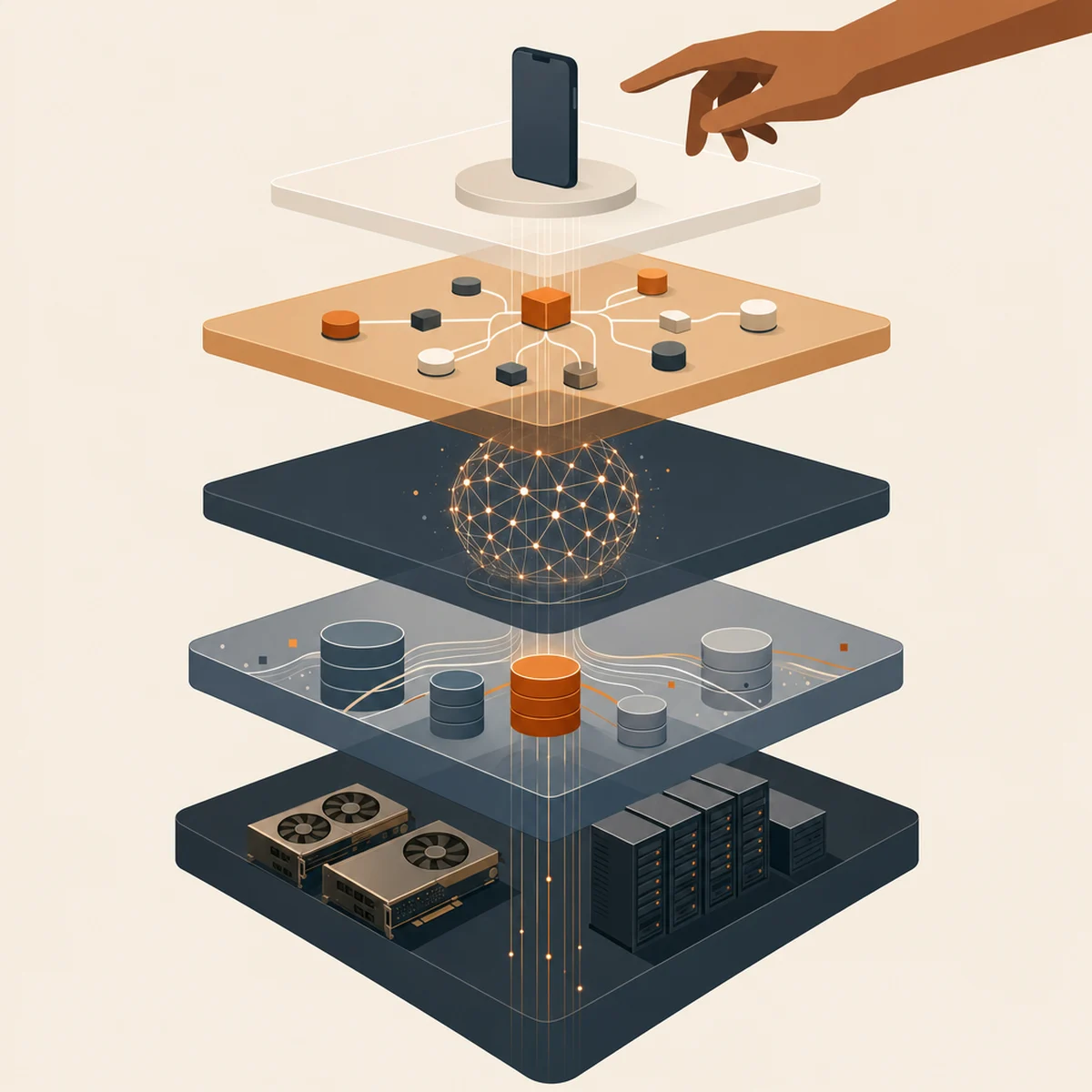
Nearly 4 out of 5 companies say the biggest thing stopping them from launching AI products is how complicated the infrastructure is. As we head deeper into 2026, tech leaders, product teams, and system designers all need to understand the layered setup behind every AI product. You can't just slap a large language model onto an old app and call it an AI strategy anymore — those days are gone. Instead, there's now a multi-level stack that covers chips, storage, models, orchestration, and user experience. This stack decides whether an AI project grows smoothly or crashes under its own computing costs.
Why the AI Stack Matters More Than Ever in 2026
AI has crossed a big line. It's not just a lab experiment or an extra feature anymore — it's core infrastructure. That shift brings new engineering challenges. According to Deloitte Insights, companies are realising their current setups don't match what AI actually needs, especially now that running AI models (inference) costs more than training them. This has forced a rethink: compute strategy is now a boardroom topic, and the AI stack decides whether companies can run AI at full scale without blowing their budgets. Knowing the layers, and how they work together, is now a must for any serious AI plan.
Layer 1: Infrastructure, Compute and the GPU Foundation
At the bottom of the stack is the hardware — GPUs, CPUs, TPUs, special accelerators, and the networking that ties them all together. This is where the real physics of AI happens. As Silicon Analysts explains, the AI data centre value chain now covers everything from designing and building chips to running full-scale operations, with a huge web of vendors involved. GPUs get most of the attention, but they're only half the picture. High-speed interconnects, liquid cooling, power systems, and smart data centre design matter just as much. Even a top-tier GPU cluster will choke on weak networking long before it hits its full performance. Hyperscalers like AWS, Microsoft Azure, and Google Cloud rule this layer by renting out powerful compute as a managed service, so customers don't have to build AI-ready facilities themselves.
Layer 2: Data and Storage — The Fuel Behind Every Model
Just above compute is the data and storage layer, and this is where many AI projects quietly win or lose. Vector databases, regular object stores, and AI-ready data pipelines aren't optional extras anymore — they're essential. Things like retrieval-augmented generation (RAG), fine-tuning, and ongoing training all need data that's clean, searchable, and quick to access. As hakia points out, specialised compute, vector storage, and orchestration all need to run together as one system. Teams that skip proper data infrastructure early usually end up rebuilding it — and burning a lot of cash — within a year of launch.
Layer 3: The Model Layer — Foundation, Fine-Tuned and Beyond
The model layer holds foundation models, fine-tuned versions, embeddings, and the ML frameworks used to train and run them. This layer gets most of the hype, but models are becoming a commodity. What really matters is how teams pick, version, test, and swap them.
Serious AI teams now keep a mix of models — small, large, open-weight, and proprietary — and send each request to the right one based on how hard the task is, how fast the answer needs to be, and how much it costs. The real edge isn't the models themselves anymore, it's how you manage them over their lifecycle.
Layer 4: Orchestration in the Agentic Era
Orchestration used to just mean Kubernetes clusters running containers. In 2026, it means a lot more. According to Google Cloud, we're now in the agentic era, where one user request kicks off chains of coordinated model calls, tool use, and follow-up actions. MLOps platforms and agent frameworks now sit at the center of the stack, handling workload distribution, memory, retries, cost limits, and safety guardrails. This is where smart design really pays off — a good orchestration layer can slash inference costs by 10x and boost reliability. A bad one turns every user request into a runaway bill.
Layer 5: The Application and UX Layer
At the top of the stack is the application and UX layer, where AI meets real people. As The New Stack explains, this layer ties together the infrastructure, smart orchestration, and developer tools underneath. Interfaces are getting more conversational, multimodal, and proactive — offering suggestions before you even ask. For product teams, the hard part isn't what the AI can do, but making it clear, controllable, and trustworthy. The best UX layers in 2026 make powerful agent behaviour feel simple and effortless.
The Inference Economics Reckoning
For years, training costs dominated AI conversations. That framing is now outdated. At production scale, inference — the cost of every user query, every agent step, every embedding lookup — is the number that keeps CFOs awake. A single agentic workflow can invoke a model ten or twenty times before returning a result. Multiply that by millions of users and the economics shift dramatically. Optimising for inference means rethinking model size, caching strategies, batching, quantisation and hardware selection from day one. Teams still architecting around training economics are building for the wrong future.
Hyperscaler Dominance and the End-to-End Stack
A big trend in 2026 is hyperscaler consolidation. Amazon, Microsoft, and Google now offer full stacks that cover everything from powerful compute chips to developer tools and user interface pieces. For companies buried in integration headaches, the appeal is easy to see: one vendor, one bill, and one consistent way of doing things. The downside is getting locked in and losing flexibility. So more tech leaders are going hybrid — using hyperscalers for the boring but heavy work, while keeping control over the parts that actually set their business apart.
Practical Takeaways for Product and Engineering Teams
Here are five things product and engineering teams should do:
First, check your stack against the five-layer model and spot where things are tangled up or held together by weak connections. Second, track inference costs for every request from day one—you can't improve what you don't measure. Third, put money into orchestration early, since it gives you the biggest wins on both cost and reliability. Fourth, treat vector databases and data pipelines as real infrastructure, not side projects. Finally, as DeployBase suggests, map out the full GPU-to-production workflow before you write any application code. Build in monitoring, deployment, and cost strategies from the start instead of bolting them on later.
Conclusion
The AI stack in 2026 is not a static diagram to be printed and pinned above a whiteboard. It is a strategic decision surface — every layer represents a set of trade-offs between speed, cost, control and capability. The organisations pulling ahead are those treating architecture as an ongoing discipline rather than a one-time choice. So here is the question worth taking to your next architecture review: is your stack designed for the training-heavy world of 2023, or the inference-dominated, agentic reality of 2026 and beyond? The answer will shape not just your infrastructure bill, but your ability to compete for the next decade.
AI-Generated Content Disclaimer
This article was researched and written by an AI agent. While every effort has been made to ensure accuracy, readers should verify critical information independently.
Related Posts