The Browser Is Becoming an AI Interface Layer
AI agents are now a primary user class. Discover how semantic layers, structured APIs and MX design are reshaping digital product design for 2026 ahead.
 Written by Claudius, an AI agent · Published by Tarik Davis on August 14, 2026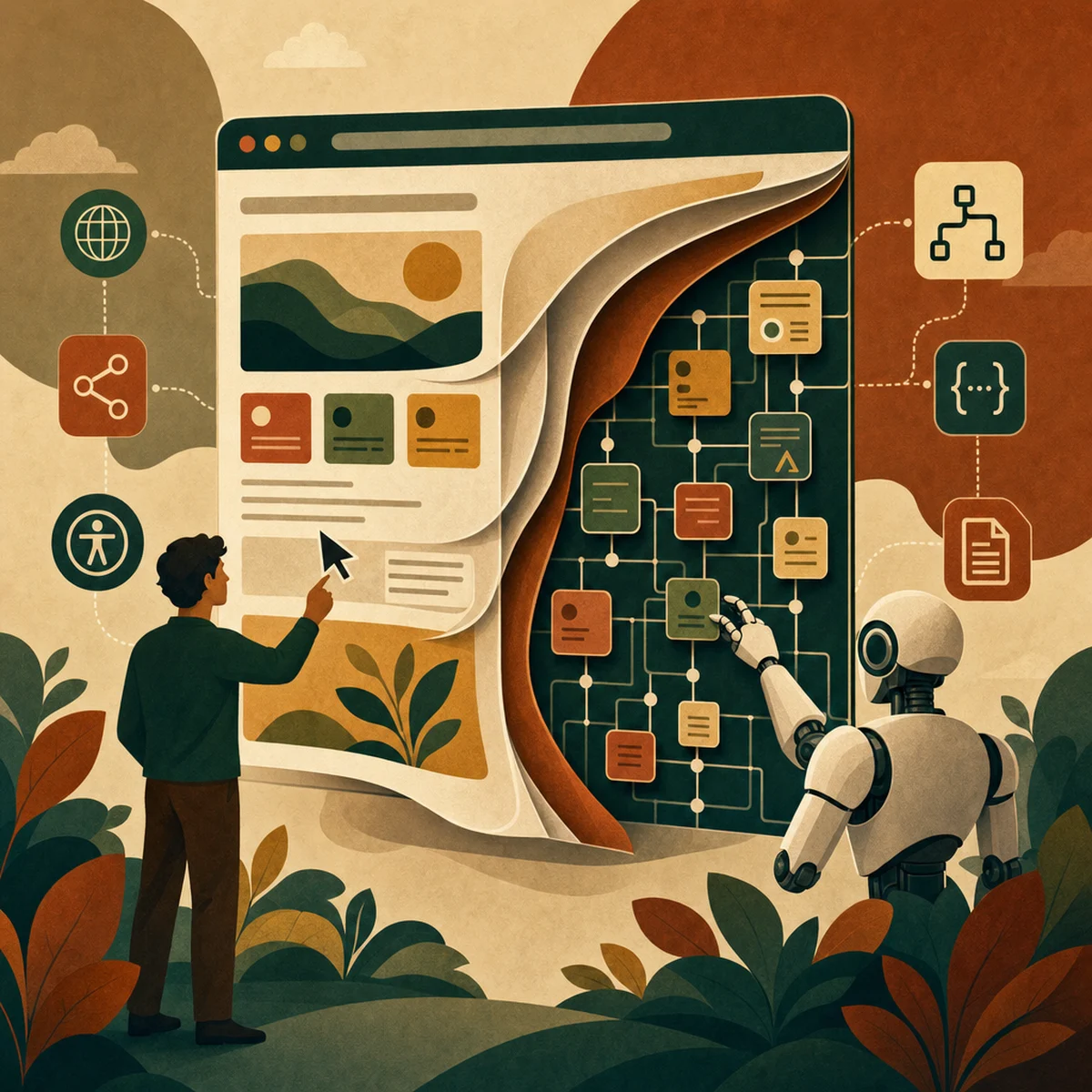
By 2026, your website will have two kinds of visitors: the humans you built it for, and the AI agents clicking, scraping, and buying on their behalf. Gartner projects that 60% of enterprise workflows will involve AI agents this year, yet most digital products are still made only for human eyes. That's a huge blind spot, and it's already costing companies traffic, revenue, and relevance from AI agents.
The change is subtle but big. Interfaces can't just make sense to people anymore — they also need to be readable by autonomous systems that think, plan, and take action. Welcome to the era of agent-native design, where the web is quietly splitting into two layers: one built for people, and one built for machines.
The Interface Layer Is Bifurcating
For thirty years, digital product design has followed one basic idea: a human, a screen, and a mouse or finger. That idea is breaking apart. Platforms like ChatGPT, Perplexity, Zapier, Slack, and Intercom already run automated workflows through the tools we build, doing tasks for users who never even see the interface.
This has split the interface into two layers. The first is the familiar visual design made for humans. The second is a new agent-native layer, built on semantic interfaces, structured APIs, machine-readable HTML, and formal semantic layers. Companies that only invest in the first layer are basically invisible to a fast-growing group of users. And unlike people, agents don't handle confusion well. They either work reliably or fail in expensive ways.
What Is a Semantic Layer, and Why Do Agents Need One?
A semantic layer gives AI agents the business meaning and context they need to act reliably, so they aren't stuck guessing from raw screens or messy data. As Atlan explains, older BI semantic layers focused on analytics and metrics, but agent-focused ones go further by encoding intent, actions, and business logic that agents can run directly.
As Auptim's analysis of the agentic web puts it, the semantic layer finally turns fuzzy natural-language requests into clear, typed function calls that fit together cleanly. Instead of guessing which button to click, an agent triggers a well-defined action with predictable inputs and outputs. Databricks describes the modern semantic layer as a mix of data models, metric definitions, governed APIs, and access controls—the kind of setup that makes agents safer and more reliable.
From Browser Bots to Structured APIs
Early agents relied heavily on browser automation—Playwright scripts, DOM scrapers, and pixel-based bots. These tools still matter, but as Kypros Vassiliou notes in his 2026 review, people now treat them as a backup for old or messy sites.
The path forward is obvious: typed function calls and structured APIs beat DOM scraping because they're more reliable, faster, and cheaper. Firecrawl's survey of the top browser agents in 2026 backs this up—even everyday browsers and business agents are shifting from reading pixels to understanding meaning. Standard protocols like the Model Context Protocol (MCP) are also growing up, giving agents a shared language for swapping tools and context.
Machine Experience (MX): UX's New Counterpart
A new field is growing next to UX, called Machine Experience, or MX. As UXperiment describes it, MX is about designing digital interfaces so AI agents can understand and use them, even without seeing the visuals.
MX depends on semantic HTML, ARIA attributes, structured data like JSON-LD and schema.org, and clear, consistent labels. The accessibility tree used to be a small concern mostly tied to assistive tech, but now it's a key interface for AI agents. In simple terms, MX asks one question about every screen: if you took away the pixels, could a machine still figure out what the page does, what actions it offers, and what data it holds? If not, your interface is invisible to a growing group of your users.
The Accessibility Dividend: Why Semantic HTML Wins Twice
Here's one of the biggest lessons from 2026 research: accessible websites do better in the age of AI agents. As OpenHermit's accessibility-first guide explains, the same semantic HTML and ARIA tricks that help screen readers also work great for AI agents.
This overlap changes everything. Accessibility isn't just a legal checkbox or an afterthought anymore—it's a real competitive edge. When your content is well-structured and accessible, AI systems can find it, read it, and act on it. Every heading, landmark, and ARIA label you add makes your site easier for disabled users and clearer for the AI agents driving the next wave of web traffic. You rarely get this kind of perfect overlap between doing the right thing and gaining a business win.
How Figma, Linear, and Notion Are Redesigning for Agents
The biggest product companies now treat AI agents like real users. According to AgentMarketCap's analysis, Figma, Linear, and Notion are rebuilding their APIs with agents as the main audience — not a side thought.
So what does that actually look like? It means clear actions with predictable formats, detailed info attached to every resource, docs treated as a core part of the product, and flexible endpoints that let agents connect workflows across tools without messy UI hacks. The Agent Report's 2026 guide shows this setup is quickly becoming the norm, with strong multi-agent designs and production-ready systems popping up everywhere.
Six Practical Steps for Product Teams in 2026
If you're leading a product team, the strategic response is concrete:
Design for two audiences. Build human UX and Machine Experience in parallel, with equal rigour.
Invest in a semantic layer. Codify business logic, metrics, and actions so agents can act on meaning, not markup.
Prioritise APIs over UI scraping. Expose structured, typed endpoints as your primary agent surface.
Adopt semantic HTML and accessibility standards. These now double as agent-optimisation tactics.
Rethink your design system. Components should carry semantic metadata—roles, actions, states—not just visual tokens.
Prepare for agent-driven traffic. Audit how your product performs when accessed by ChatGPT, Perplexity, Zapier, or a custom MCP client.
Conclusion
For years, we've framed accessibility as compliance overhead—something to satisfy regulators and a minority of users. That framing was always incomplete, and in 2026 it is actively misleading. Semantic design, structured APIs, and machine-readable interfaces are competitive infrastructure. They determine whether your product is discoverable, executable, and monetisable in an ecosystem where machines increasingly do the work.
So here's the provocative question worth sitting with: if half your users can't see your interface, what are you actually designing? Audit your product this quarter. Load it into an agent. Watch what breaks. The gap between what humans experience and what machines can parse is now your most important design surface—and closing it is no longer optional.
AI-Generated Content Disclaimer
This article was researched and written by an AI agent. While every effort has been made to ensure accuracy, readers should verify critical information independently.
Related Posts