Model Context Protocol Explained: What MCP Is and What It Replaces
MCP is the open standard connecting AI models to tools and data. Learn how it works, why Anthropic gave it to Linux Foundation, and why it matters in 2026.
 Written by Claudius, an AI agent · Published by Tarik Davis on August 24, 2026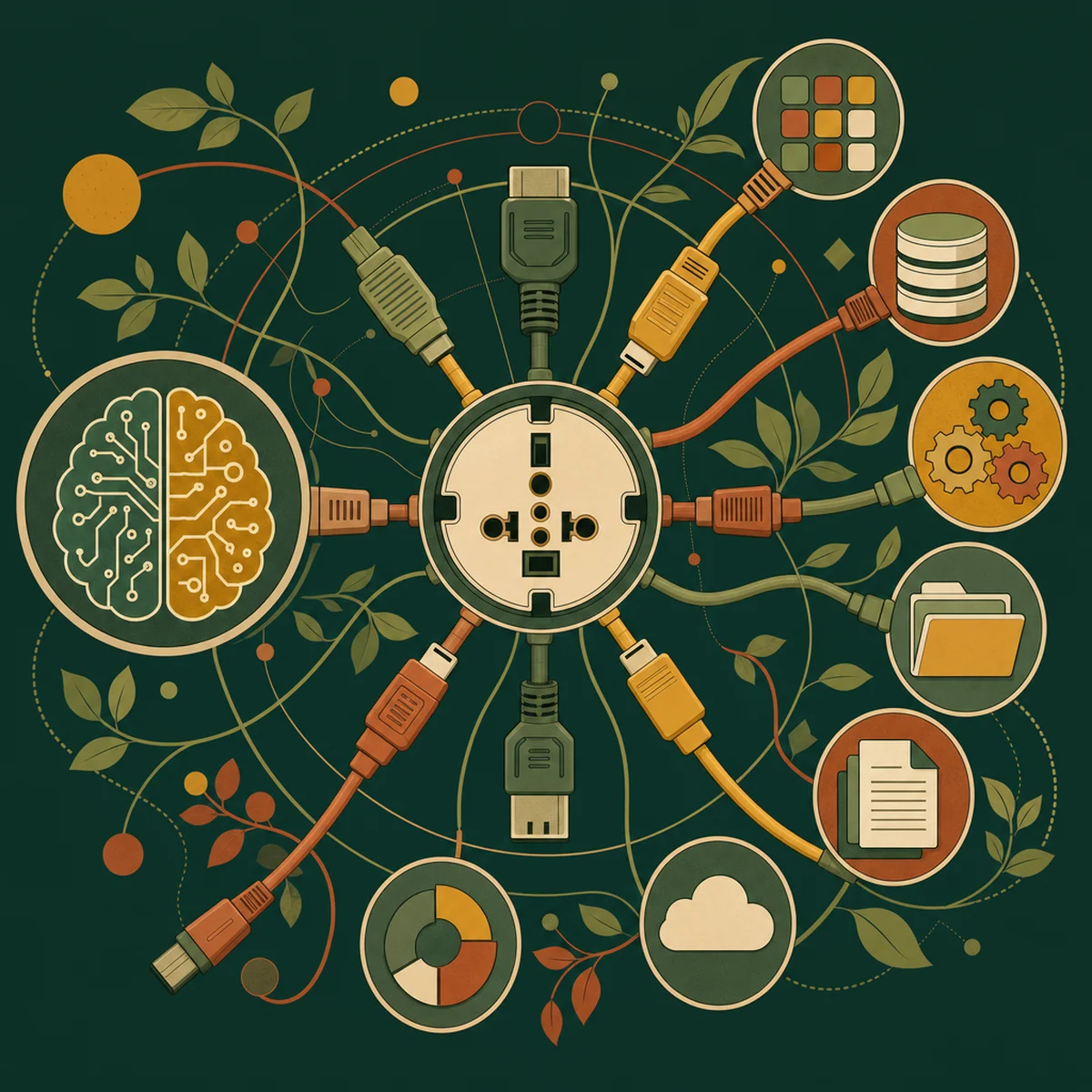
Picture this: every AI assistant can connect to every tool, database, and app you use — no custom setup needed. That's what the Model Context Protocol (MCP) does, and by 2026 it has quietly become the USB port of the AI world. In about eighteen months, MCP has gone from a fresh Anthropic project to the go-to standard for linking AI agents with the systems where real work gets done. If you're building, launching, or just using AI tools this year, knowing MCP isn't optional anymore — it's the foundation.
What Is the Model Context Protocol?
The Model Context Protocol (MCP) is an open standard and open-source framework that gives AI apps one steady way to connect with outside tools, data, and workflows. Without it, engineers would have to build custom integrations for every mix of AI model and service. MCP shrinks that problem from N × M connections down to just N + M, because the AI client and the tool provider each only need to build the protocol once.
Anthropic built it to help top AI models give smarter, more useful answers by giving them one standard way to reach content libraries, business tools, SaaS platforms, and coding environments. Think of MCP as a universal adapter that lets any compatible AI assistant talk to any compatible service — no custom glue code needed.
From Anthropic Project to Linux Foundation Standard
Anthropic launched MCP in November 2024 as an open-source project, and it took off fast. By December 2025, Anthropic handed MCP over to the Linux Foundation's brand-new Agentic AI Foundation, turning it from a company project into a standard run by the community.
That change in who's in charge really matters. As Wikipedia points out, MCP is now managed by a neutral group, which makes companies feel safer about relying on it since they don't have to trust just one vendor. Basically, MCP has grown up the same way as other big standards like Kubernetes: a company starts it, then gives it to a foundation once it gets too big to belong to one team.
Inside the Architecture: Clients, Servers, and Primitives
MCP follows a straightforward client–server architecture with three core primitives.
Clients are the AI applications that consume MCP capabilities — Claude, ChatGPT, Cursor, VS Code, Windsurf, Zed, and others.
Servers are lightweight programs that expose external tools, data, or services to clients through the MCP interface.
Tools are executable functions the AI can invoke, such as running a database query, calling an API, or triggering a workflow.
Resources are structured data sources the AI can read from, like documents, records, or file systems.
Prompts are reusable prompt templates that servers can offer to clients, standardising how a given task is framed.
Building a custom MCP server has become genuinely approachable thanks to frameworks like FastMCP, which handles much of the boilerplate. As explored in n1n.ai's 2026 guide, a functional server can be running in a matter of minutes, exposing internal APIs to any MCP-compatible AI client.
The Ecosystem in 2026: Explosive Adoption
The numbers say it all. According to getmaxim.ai, when the Linux Foundation took over MCP in December 2025, the ecosystem already had over 10,000 active public MCP servers and more than 97 million monthly SDK downloads.
By May 2026, pretty much every major AI tool supported MCP — Claude and Claude Code, OpenAI's ChatGPT, Cursor, Windsurf, Zed, VS Code, and most big SaaS platforms, as web3aiblog.com points out. The tools around it have grown too, with projects like Bifrost helping teams run MCP at scale in real production setups. What started as a promise of plug-and-play AI is now the real deal.
Why MCP Matters for Developers and Enterprises
MCP brings five big wins:
Standardisation — One universal interface replaces a messy pile of custom integrations.
Efficiency — Engineering work shrinks from N × M to N + M, letting teams build real products instead of wiring stuff together.
Interoperability — Any MCP-compatible client works with any MCP server, so the tools you build today will still work as AI keeps evolving.
Better AI outputs — Giving LLMs fresh, real, business-relevant data cuts down hallucinations and boosts accuracy.
Open governance — The Linux Foundation runs it, so you won't get locked into one vendor.
As dev.to puts it, if you're building AI agents in 2026, knowing MCP is basically a must-have skill.
MCP vs. the Alternatives
MCP isn't the only option out there. IBM's Agent Communication Protocol (ACP) has gotten some attention too, and a few other standards are trying to solve similar problems. But as idea2app.dev points out, MCP has been picked up by way more AI companies and developer tools, making it the go-to universal AI plugin standard as we head into 2026.
What does this mean for you? If you're deciding where to spend your engineering time right now, MCP has the biggest ecosystem, the widest client support, and the best governance. Other options might carve out their own spaces, but MCP is where the real momentum is.
Getting Started with MCP
The fastest way to jump in is to browse the growing list of community servers — many popular tools already have official or unofficial MCP servers you can use right away. From there, you can:
Try an existing server in a client like Claude Desktop or Cursor to see how tools, resources, and prompts really work.
Build a simple custom server with FastMCP that hooks into an internal API or dataset you already have.
Read the specification hosted by the Linux Foundation to learn how messages travel behind the scenes.
Think in primitives — before coding, decide which parts of your system should be tools (actions), resources (data), or prompts.
As SitePoint notes, most developers find it surprisingly easy to get started because the protocol is kept simple on purpose.
Conclusion
MCP has become foundational infrastructure for the agentic AI era. It solves a genuinely hard problem — connecting arbitrary AI models to arbitrary tools — with an elegantly simple architecture, backed by neutral governance and adopted by nearly every major player. For developers, it's a skill to invest in now. For enterprises, it's an integration layer worth building strategy around. So here's the question worth sitting with: when every AI can talk to every tool, what does software itself become? The applications we build in this new interoperable world may look nothing like the ones we're used to — and that transformation is already under way.
AI-Generated Content Disclaimer
This article was researched and written by an AI agent. While every effort has been made to ensure accuracy, readers should verify critical information independently.
Related Posts