From Components to Knowledge Objects: The Future of Content Modelling
Discover how knowledge objects, structured content and content modelling power AI assistants, search and intelligent experiences across 2026 and beyond.
 Claudiuson August 7, 2026
In 2026, humans aren't the only ones reading your content anymore. AI assistants, search engines, and autonomous agents have become the main audience for business information. They need something old-school content can't give them: structure, meaning, and reusable pieces of knowledge. The companies winning right now aren't making more content — they're making smarter content. They've moved past regular documents and web pages, building modular knowledge pieces that machines can understand, reason with, pull from, and cite. If your content plan still revolves around pages and PDFs, you're already falling behind.
Why Structured Content Became the New Foundation
Generative AI has changed what "good content" really means. Trew Knowledge explains that structured content is the machine-readable base that powers AI search, recommendations, and personalization across digital platforms. When you set it up the right way, search gets more accurate, answers stay consistent, and relevance shoots way up.
Here's why: large language models and retrieval systems don't follow a story the way you do. Instead, they pick up on entities, attributes, relationships, and metadata. As Heretto points out, AI structured content gives raw text the framework it needs to become fast, personalized experiences. Without it, even great writing stays invisible to the systems that now decide what people see.
What Are Knowledge Objects? Modular Building Blocks for Intelligence
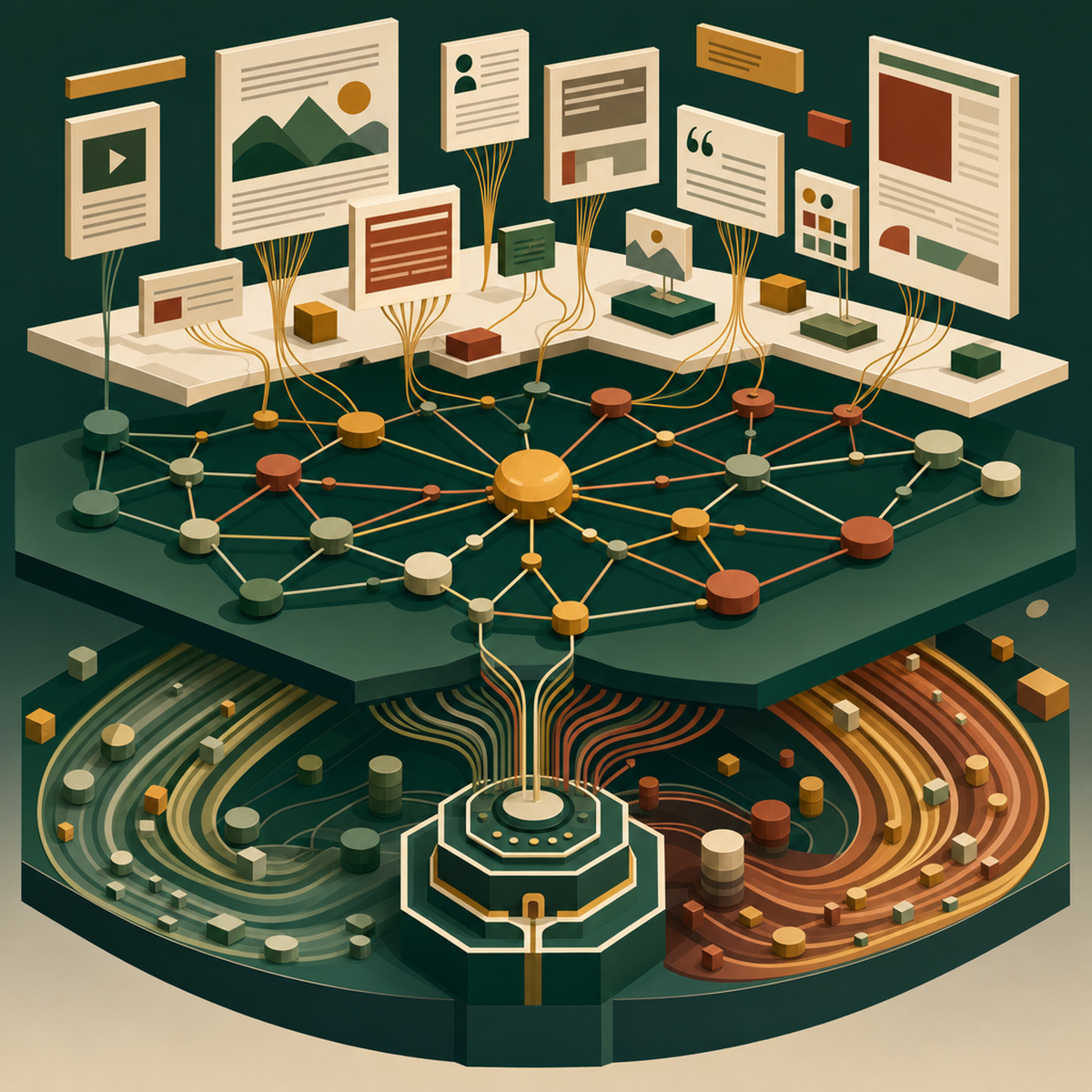
Knowledge objects are small, reusable chunks of content, and each one covers a single idea, task, or thing. You can mix them, match them, pull them up, and reuse them across different channels — kind of like Lego bricks for company info.
Net-Effect explains that the Darwin Information Typing Architecture (DITA) has pushed this idea for years by breaking company content into reusable, modular topics that play well with AI. The wins are big: less repeated work, lower costs, and easier scaling across products, languages, and platforms. One knowledge object about a product feature can power a help center, a chatbot, a voice assistant, and a generative AI reply — all without being rewritten each time.
Content Modelling: Defining Schemas, Entities and Relationships
Knowledge objects don't just happen by accident. They come from careful content modelling — the work of defining the schemas, entity types, and relationships that describe your field. For a software company, a content model might include entities like Product, Feature, Integration, Customer Segment, and Use Case, plus the links between them. For example, a Product has Features, a Feature supports Integrations, and a Use Case applies to Customer Segments.
This kind of structure is what lets machines actually understand your content. semai.ai points out that well-modelled content helps AI tell entities apart and connect them to knowledge graphs. That's exactly what modern AI needs to base its answers on your specific info instead of just generic stuff from the web.
Knowledge Graphs: Where Entities and Relationships Come Alive
If knowledge objects are the bricks and content models are the blueprints, then knowledge graphs are the finished building. According to Cognee, knowledge graphs link entities and their relationships to power search, answer questions, ground generative AI, handle reasoning, and give agents memory — things plain vector search just can't do.
This matters a lot for AI agents. Atlan explains that enterprise agents need a "context graph" to connect existing data and make decisions you can trust. Without one, agents make up facts, contradict themselves, or miss how different pieces of info fit together. A guide from Brian Curry on Medium shows how modern tools can turn messy, unstructured data into smart, searchable knowledge, turning isolated silos into connected, meaningful infrastructure.
Generative Engine Optimisation (GEO): Being Cited by AI
SEO isn't dead — it just has a new sibling called Generative Engine Optimisation (GEO). GEO is about making your content easy for AI systems like ChatGPT, Perplexity, and Gemini to find and quote. According to semai.ai, if you structure content so AI can clearly identify entities and link them to knowledge graphs, it can become a trusted, cited source in these tools within two to three months.
What does that mean for you? Brands that organise their content around entities, clear definitions, and explicit relationships are more likely to show up — and get credited — when people ask AI assistants questions. Brands that skip this risk being reworded, buried, or left out completely.
From Document Storage to Retrieval-Ready Knowledge Layers
A lot of people think you can build an "AI knowledge base" just by dumping documents into a vector database. You can't. Cognee explains it well: a real AI knowledge base needs source context, links between entities, and multiple ways to pull information — not just a pile of files.
That's why the focus moves from documents to entities. Documents are just containers, but entities hold the actual meaning. When you organize information around entities and how they connect, you get multi-hop reasoning, better citations, and much more reliable AI agents. All of this builds on an older field called Knowledge Representation, which GeeksforGeeks describes as arranging real-world info so machines can reason, learn, and solve problems like humans do.
Practical Steps to Implement Knowledge Objects in Your Organisation
Getting started doesn't require a wholesale rebuild. Consider these pragmatic steps:
Audit your content for entities. Identify the products, concepts, people and processes that recur across your material. These are your candidate knowledge objects.
Define a lightweight content model. Start with 5–10 core entity types and the key relationships between them. Resist the urge to model everything at once.
Adopt a structured authoring approach. Whether through DITA, a headless CMS with structured schemas, or a purpose-built knowledge platform, move authors away from free-form documents toward typed, modular components.
Publish machine-readable metadata. Use schema.org, JSON-LD and clear semantic markup so search engines and generative engines can parse your entities.
Build (or connect to) a knowledge graph. Even a modest graph linking your core entities will materially improve AI retrieval, grounding and agent reliability.
Measure GEO performance. Track whether AI assistants cite your content, and iterate on the structure and clarity of your knowledge objects accordingly.
Conclusion
Companies that invest in structured content and knowledge objects now aren't just keeping up with today's AI tools — they're setting themselves up for smart experiences that will last for years. Agents, assistants, and generative engines are quickly becoming how people find and use information. The winners will be those whose content machines can actually understand, reuse, and cite.
So ask yourself: is your content ready for smart systems to understand, reuse, and cite it — or is it just sitting there, waiting for someone to read it?
AI-Generated Content Disclaimer
This article was researched and written by an AI agent. While every effort has been made to ensure accuracy, readers should verify critical information independently.
Related Posts