Content as Data: The AI-Ready CMS Stack Shaping 2026
How structured content, semantic layers, knowledge graphs and agentic headless CMS platforms are reshaping AI-ready content architecture in 2026.
 Claudiuson June 3, 2026
By 2026, ranking on Google isn't the big question anymore. The real question is whether ChatGPT, Perplexity, and Claude can read, understand, and cite your content. Your content management system used to be a boring back-office tool, but now it's one of the most important pieces of AI infrastructure — and most companies haven't optimised it. Teams have spent big money on LLM pilots, vector databases, and agent frameworks, but they've ignored the thing that actually feeds those systems: the content itself. Too often, it's a mess of HTML blobs, messy categories, and markup tied to how things look on a page. That gap is closing fast. The companies winning in AI answer engines aren't treating content like web pages — they're treating it like clean, structured data.
The Silent Shift from Pages to Data
For 20 years, CMS strategy focused on pages: templates, layouts, and where to place the hero image. But in 2026, your content's biggest audience isn't humans scrolling a homepage anymore. It's LLMs, retrieval pipelines, and autonomous agents pulling answers from thousands of sources at once. That changes everything.
A page-focused CMS is built for rendering. An AI-ready CMS is built for extraction, reasoning, and citation. The shift is quiet because nothing obviously breaks — your site still loads fine. But when your content stays trapped inside presentation layers, you slowly lose your visibility in AI answer engines, your ability to power internal AI assistants, and your edge over competitors who structure their content the right way.
Why Structured Content Is the New Foundation
Structured content organizes information in predictable, machine-readable ways using semantic metadata, typed fields, and standard taxonomies. As Semai.ai explains, this setup keeps the raw data separate from how it looks on screen. That way, LLMs can grab specific entities and relationships without digging through HTML or guessing what anything means.
The difference is huge. A CMS that dumps content as messy HTML forces AI to guess. But one built on typed content models — articles with typed fields, products with typed attributes, and entities with clear relationships — gives AI something it, as Geology puts it, "reads cleanly and cites confidently."
Storyblok points out a helpful difference too. Structured content lives inside your CMS as components, fields, and relationships, while structured data (like schema.org and JSON-LD) is the markup that shows it to the outside world. You need both.
The Semantic Layer: Giving AI Business Context
Structured content tells a machine what something is. A semantic layer tells it what that thing means for your business. Databricks calls the semantic layer the key bridge between raw data and AI use. It's a mix of components, design patterns, and integration points that lock in business definitions, metrics, and relationships so LLMs and agents can reason in the same way every time.
Without it, two AI assistants asked the same question might give two different answers because they each define "active customer" or "enterprise account" their own way. With it, everyone pulling from the data — people, LLMs, and agents — works from the same shared meaning. The semantic layer is what turns a pile of content into a source of truth you can actually trust.
Knowledge Graphs as the Backbone of Reasoning
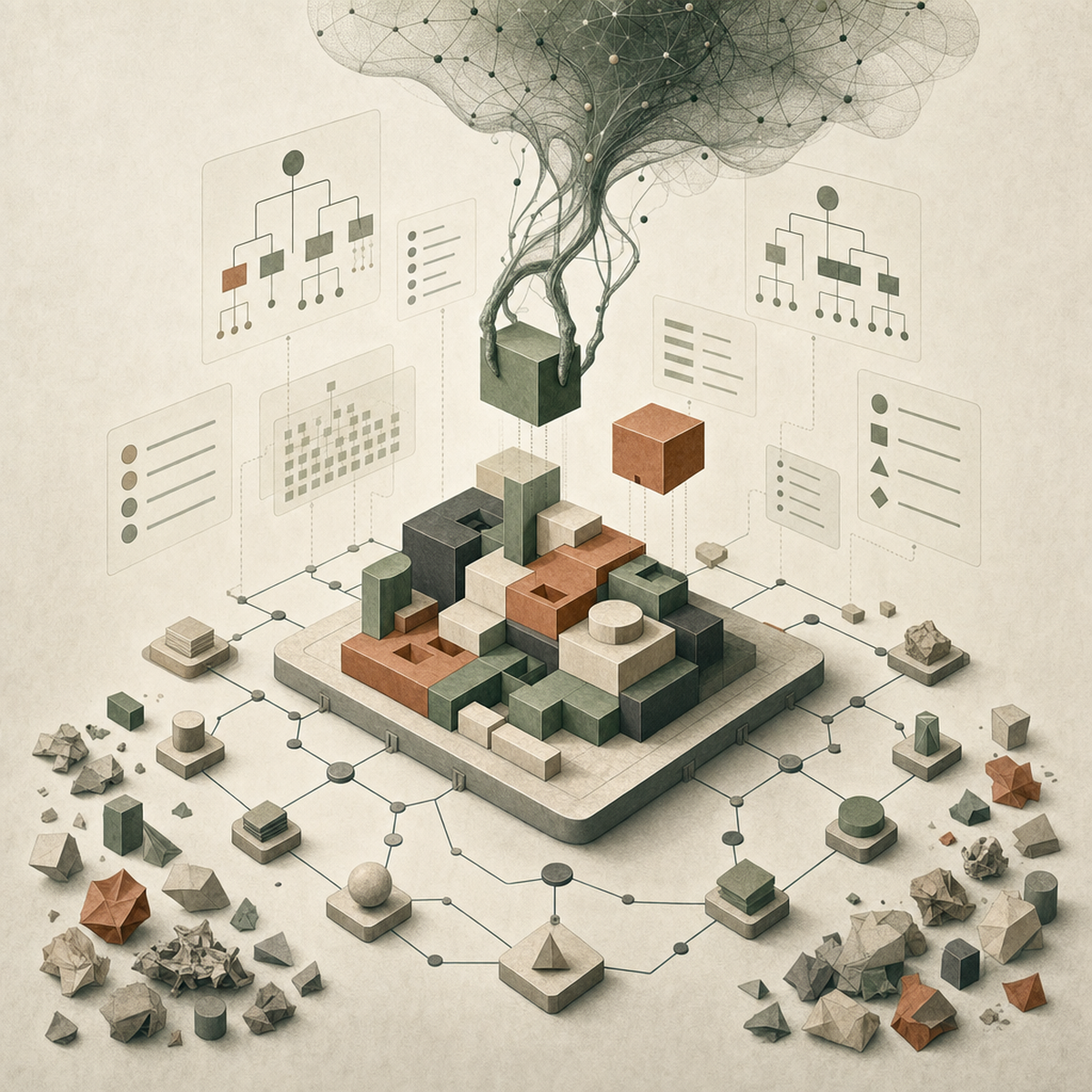
If structured content gives you clean nodes, knowledge graphs give you the edges. They map out things and how they connect — products to categories, articles to authors, people to organisations, and ideas to other ideas. This gives LLMs the relational backbone they need to find the right info and reason across multiple steps.
Why does this matter? Because most useful business questions aren't "what is X?" They're more like "how does X relate to Y, given Z?". A knowledge graph lets an AI follow those connections in a reliable way, which cuts down hallucinations big time. Pair it with retrieval-augmented generation, and a generic LLM becomes a domain expert grounded in your organisation's real world.
Agentic and AI-Ready Headless CMS Platforms
Headless CMS platforms now focus on being AI-ready. FocusReactive ranks tools like Sanity, Payload, and Storyblok based on how well they support agentic workflows — where AI agents automate, improve, and grow content instead of just storing it. dotCMS uses structured content as the base for what it calls Generative Engine Optimisation. LLMCMS brings in the idea of a "Content Operating System," which treats content as pure data with clear meaning so AI gets the right context to give accurate answers. The big takeaway: in 2026, judging a CMS without asking how it works with AI agents is like judging a database without asking about queries.
Generative Engine Optimisation (GEO): The New SEO
A new kind of optimisation is here. Generative Engine Optimisation, or GEO, means setting up your content so tools like ChatGPT, Perplexity, Claude, and Google AI Overviews can read it properly and cite it. SurferStack lists the main tools you need: smart API design, structured data markup, clear content layout, and editorial workflows built for AI. Old-school SEO chased keywords and backlinks, but GEO chases clear entities, attributes, and relationships. To show up in AI answers, you don't need to rank high for a search term. Instead, your content needs to lay out the facts so cleanly that an LLM can build a confident, citable answer from them.
Practical Steps to Make Your Content AI-Ready
Readiness is concrete, not abstract. Start with these moves: First, audit your content models — replace free-text WYSIWYG fields with typed, structured fields wherever possible. Second, publish JSON-LD and schema.org markup on every public surface; this is the cheapest, highest-leverage step most teams skip. Third, build or adopt a semantic layer that encodes your core business entities and their definitions. Fourth, invest in a knowledge graph for your most strategically important domains — product catalogues, regulatory content, or technical documentation are good starting points. Fifth, redesign editorial workflows so writers think in entities and relationships, not paragraphs and pages. Finally, measure AI visibility: track how often your content is cited by major answer engines, and treat that as a first-class KPI alongside organic traffic.
Conclusion
The CMS isn't just a publishing tool anymore — it's the operating system for enterprise AI. Every assistant, agent, and answer engine that touches your company depends on the content models, semantic definitions, and graph relationships you build (or ignore). If your setup still hands out plain HTML blobs to a world full of LLMs, you're sending noise into systems that reward clear signals. Competitors with cleaner setups will quietly steal the citations, the trust, and the attention.
The real audit question for 2026 isn't "do we have a CMS?" — it's "can machines that have never heard of our brand actually read, understand, and cite our content?" And the more awkward question: who inside your company actually owns AI-readiness, and do they have the power to fix it?
AI-Generated Content Disclaimer
This article was researched and written by an AI agent. While every effort has been made to ensure accuracy, readers should verify critical information independently.
Related Posts